
This free privacy tool makes it super easy to see which sites are selling your data
Free Privacy Tool Makes It Super Easy to Stop Websites from Selling Your Data — Here’s How
The Growing Threat to Your Digital Privacy
Every day, without most people even realizing it, websites you visit are collecting, storing, and selling your personal data to third parties. These hidden data brokers operate in the shadows of the internet, tracking your every click, purchase, and interest to build detailed profiles about you. What’s worse? Many of these companies hide the opt-out links required by privacy laws in places so obscure you’d never find them.
The Global Privacy Control Movement: Your Digital Shield
Enter the Global Privacy Control (GPC) — a revolutionary movement that started in 2020 to give you back control of your online privacy. Inspired by California’s groundbreaking Consumer Privacy Act, GPC has evolved into a comprehensive solution that makes opting out of data selling automatic and effortless.
How GPC Works Its Magic
Think of GPC as your personal privacy bodyguard that travels with you across the internet. Once activated, it sends a clear signal to every website you visit: “Do not sell my personal information.” No more hunting for hidden opt-out links or remembering to click through endless privacy settings.
The Tools You Need: Browsers and Extensions That Support GPC
The beauty of GPC is its versatility. You can implement it through several methods:
Built-in Browser Support:
- Brave Browser (complete with built-in protection)
- DuckDuckGo Browser (privacy-first design)
- Firefox (with GPC enabled in settings)
- Safari (supports GPC signals)
Powerful Browser Extensions:
- OptMeowt (the original GPC extension)
- Global Privacy Control extension
- Privacy Badger
- uBlock Origin (with GPC features)
Real-World Testing: Does It Actually Work?
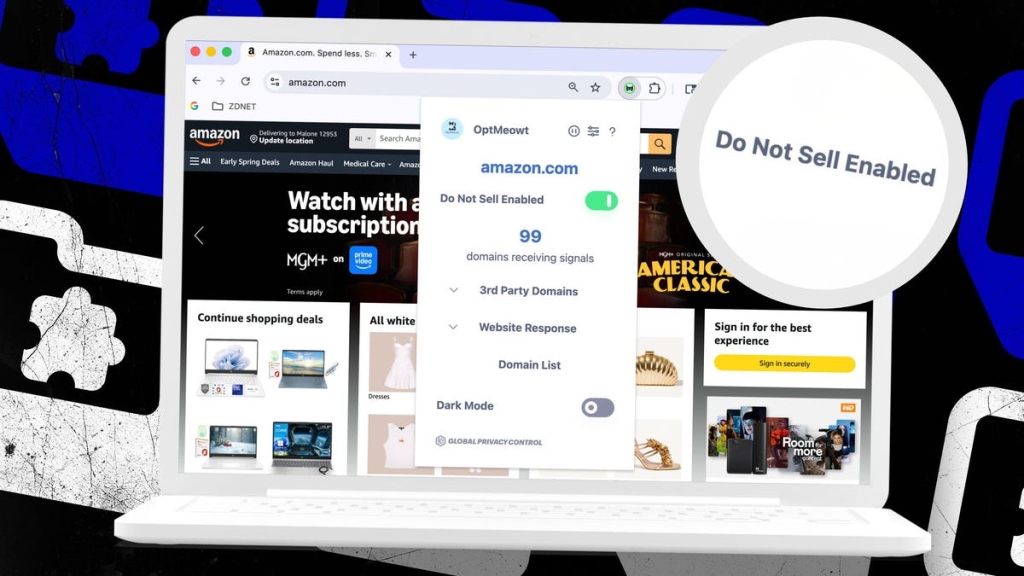
I put GPC to the test using OptMeowt, and the results were eye-opening. As I browsed my usual websites, the extension revealed something shocking: nearly every site was sending data to multiple third-party domains. Even my home lab applications were quietly sharing information with external services I never authorized.
The extension displays a simple traffic light system:
- Green: Site is in compliance and honoring your privacy request
- Yellow: Site is partially compliant
- Red: Site is not in compliance and may be selling your data
Security Considerations: What You Need to Know
While testing OptMeowt, I discovered it received a 5.0/10 security rating on LayerX Security’s index. Two critical warnings stood out: permission to access network traffic and scripting capabilities. However, these permissions are necessary for the extension to function properly. The network access allows it to monitor data requests, while scripting permissions enable it to inject the GPC signal into websites.
Despite these warnings, OptMeowt remains a featured extension on the Google Web Store, and I haven’t encountered any security issues during my testing. For those concerned about extension security, built-in browser features like Brave or DuckDuckGo offer worry-free alternatives.
The Current State of Privacy Laws
Here’s the frustrating reality: while GPC is incredibly powerful, its effectiveness is limited by the patchwork of privacy laws across the United States. The California Consumer Privacy Act (CCPA) primarily protects California residents, though it extends to any business collecting data from Californians.
Currently, only 20 U.S. states have comprehensive data privacy laws, leaving the majority of Americans without strong legal protections. This means GPC works best when visiting sites from states with robust privacy regulations, but its effectiveness varies widely depending on your location and the websites you visit.
Why This Matters More Than Ever
In our data-driven economy, your personal information is incredibly valuable. Companies use it to:
- Target you with personalized advertising
- Sell your data to data brokers
- Build detailed consumer profiles
- Predict your behavior and preferences
- Influence your purchasing decisions
Without protection like GPC, you’re essentially leaving your digital front door wide open for anyone to walk in and take what they want.
Getting Started: Your Privacy Protection Plan
Ready to take control of your digital privacy? Here’s your action plan:
- Choose your GPC method: Select either a supported browser or install an extension
- Install and configure: Follow the simple setup instructions
- Browse with confidence: Visit your favorite sites and watch GPC work
- Monitor compliance: Use the visual indicators to see which sites respect your privacy
The Bottom Line
GPC represents a significant step forward in consumer privacy protection. While it’s not perfect — and won’t work on every website — it provides unprecedented visibility into how your data is being shared and gives you the power to say “no” to data selling.
In a world where privacy is increasingly under threat, tools like GPC aren’t just convenient; they’re essential. Your personal data is valuable, and you deserve to control who has access to it.
Also check out:
- How to stop iPhone apps from tracking you
- 6 free ways to lock down your home Wi-Fi
- How to clean up your digital footprint
- Why I switched to Tor Browser on Android
Tags: #Privacy #DataProtection #GlobalPrivacyControl #OnlineSecurity #CCPA #DigitalRights #BrowserExtensions #DataPrivacy #InternetPrivacy #OnlineSafety
Viral Phrases:
- “Your data is being sold right now”
- “The privacy tool hiding in plain sight”
- “Stop websites from tracking you automatically”
- “Take back control of your digital life”
- “The free tool that protects your privacy”
- “How to opt out of data selling everywhere”
- “The browser feature that changes everything”
- “Your personal information is valuable currency”
- “The privacy movement that’s going viral”
- “Stop being tracked online for free”
- “The extension that reveals data brokers”
- “Why your privacy matters more than ever”
- “The simple fix for complex privacy problems”
- “How to make websites respect your privacy”
- “The future of online privacy is here”
,


Leave a Reply
Want to join the discussion?Feel free to contribute!