
This Galaxy Is 99% Dark Matter—and Basically Invisible
NASA’s Hubble Telescope Uncovers One of the Darkest Galaxies Ever Seen—And It’s Hiding in Plain Sight
In a discovery that’s sending shockwaves through the astrophysics community, NASA’s Hubble Space Telescope has identified what could be one of the darkest, most elusive galaxies ever detected—a cosmic ghost lurking within one of the universe’s most crowded neighborhoods.
The Invisible Majority
Dark matter doesn’t emit, absorb, or reflect light. It’s invisible to every instrument we’ve ever built, yet scientists estimate it comprises a staggering 85% of all matter in the universe. This unseen substance has become the cornerstone of modern cosmology, the invisible scaffolding upon which galaxies form and evolve.
Without dark matter, our entire understanding of how the universe works would collapse like a house of cards. The rotation curves of galaxies, the distribution of cosmic microwave background radiation, the large-scale structure of the universe itself—all point to something we cannot see but must exist.
A Ghost Among Stars
Last summer, astronomers scouring the cosmos for candidates of so-called “dark galaxies”—rare celestial objects with remarkably low surface brightness—struck cosmic gold. Their findings, published in The Astrophysical Journal Letters, suggested these dark galaxies should possess “some of the most extreme properties among all known galaxies.”
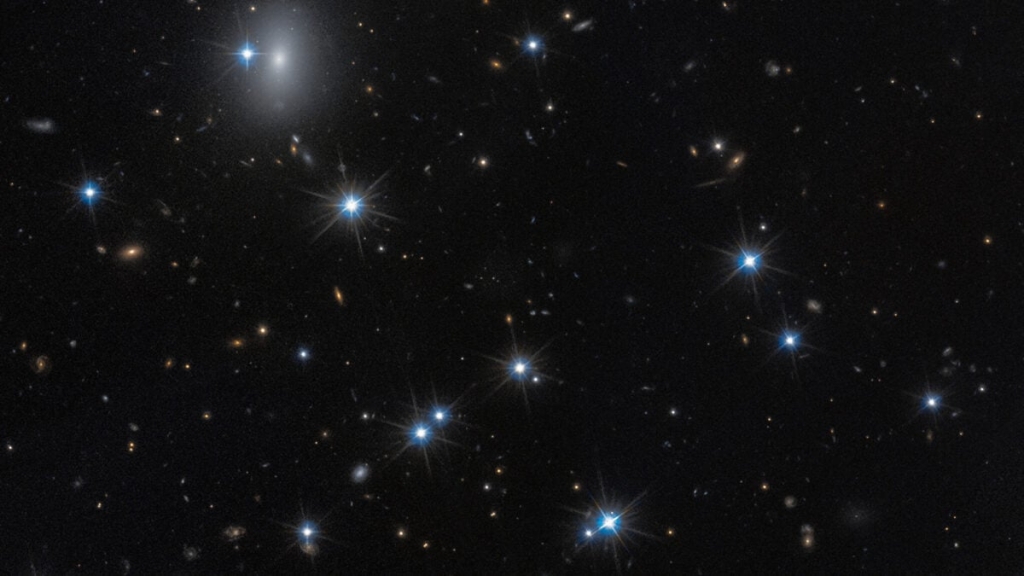
Today, NASA released high-resolution images of one such candidate: CDG-2. If current hypotheses hold true, this galaxy would rank among the most heavily dark-matter-dominated objects ever identified in the observable universe.
Seeing the Unseen
How do you detect something that doesn’t interact with light? Astronomers rely on dark matter’s gravitational influence—the way it bends space-time and affects the motion of visible objects around it. It’s like inferring the presence of an invisible hand by watching how it moves objects in its vicinity.
The mathematics is compelling. Remove dark matter from our equations, and galaxies should fly apart. Stars at the edges of galaxies orbit far too quickly to be held by visible matter alone. Something unseen must be providing the extra gravitational glue.
The Perseus Cluster’s Hidden Treasure
CDG-2 resides within the Perseus galaxy cluster, a region of space teeming with globular clusters—tightly bound collections of millions of stars packed into dense, spherical arrangements. This cosmic neighborhood is renowned for its exceptionally rich population of these stellar cities.
When Hubble, ESA’s Euclid mission, and the Subaru Telescope in Hawaii zoomed in for a closer examination, they detected something extraordinary: a faint, ghostly glow encircling a tight grouping of four globular clusters. The question arose: were these four separate clusters, or pieces of a single, larger structure?
Statistical Certainty
The research team conducted rigorous statistical analysis of the region. Their calculations strongly suggest these four clusters aren’t independent objects but components of one galaxy—and a particularly dark one at that.
“This is the first galaxy detected solely through its globular cluster population,” explained David Li, the study’s lead author and astronomer at the University of Toronto, in a NASA release.
99% Darkness
The numbers are mind-bending. CDG-2 possesses a luminosity equivalent to roughly 6 million Sun-like stars, with those four globular clusters contributing approximately 16% of that total brightness. But when it comes to mass, the picture changes dramatically: an estimated 99% of the galaxy’s mass appears to be dark matter.
The normal matter—primarily hydrogen gas that would typically form new stars—was likely stripped away by the intense gravitational environment of the Perseus cluster’s dense population. Even if CDG-2 doesn’t qualify as a textbook “dark galaxy,” it remains an astronomical oddity that defies conventional understanding.
Why This Matters
This discovery represents more than just another cosmic curiosity. CDG-2 provides astronomers with an unprecedented laboratory for testing theories about galaxy formation, star cluster dynamics, and the fundamental nature of dark matter itself.
The galaxy’s extreme properties challenge existing models and may help resolve long-standing questions about how galaxies evolve in dense environments. Is CDG-2 a failed galaxy that never accumulated enough normal matter? A victim of cosmic strip-mining? Or something entirely new that our current theories haven’t anticipated?
The Dark Matter Detective Story Continues
As astronomers continue their cosmic detective work, discoveries like CDG-2 remind us that the universe still holds profound secrets. Each observation brings us closer to understanding the invisible majority that shapes our cosmos, even as it raises new questions about the fundamental nature of reality.
One thing remains certain: in the grand cosmic mystery of dark matter, we’ve only just begun to read the first chapters of what promises to be the most fascinating detective story in scientific history.
Tags: dark matter, dark galaxy, Hubble Space Telescope, NASA discovery, Perseus galaxy cluster, cosmology, astrophysics, invisible universe, globular clusters, cosmic mystery, space exploration, astronomical breakthrough
Viral Phrases: “99% dark matter galaxy discovered,” “NASA finds invisible galaxy hiding in plain sight,” “The universe’s darkest secret revealed,” “Ghost galaxy detected through globular clusters,” “Dark matter detective story,” “Cosmic strip-mining mystery,” “The invisible scaffolding of the universe,” “Astronomy’s greatest detective work,” “Space’s best-kept secret uncovered,” “Mind-bending cosmic discovery”
,


Leave a Reply
Want to join the discussion?Feel free to contribute!