
This Tiny Fish Passed an Intelligence Test That Once Distinguished Great Apes : ScienceAlert
Tiny Fish Show Astonishingly Mammal-Like Intelligence in Mirror Experiments
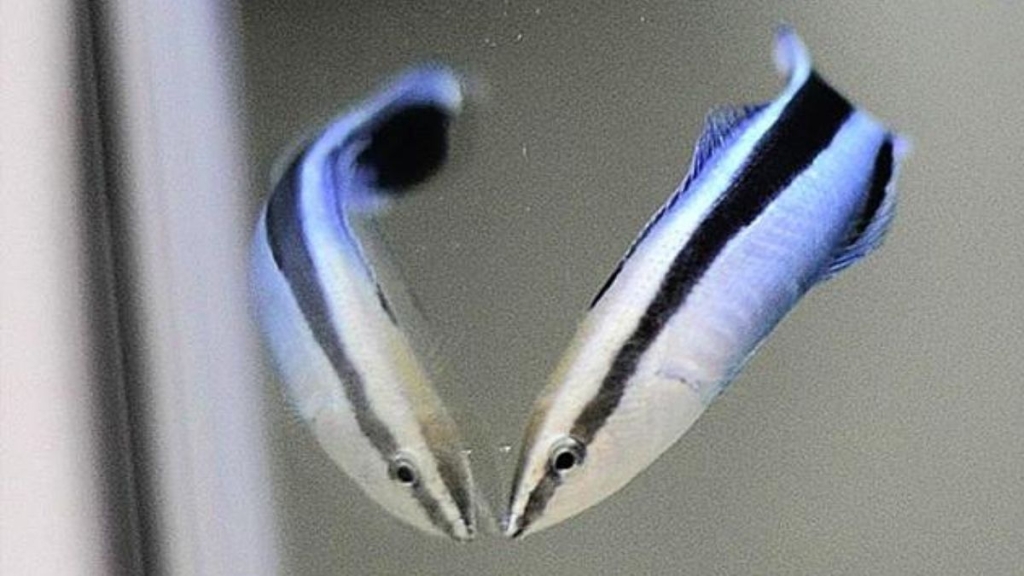
In a groundbreaking series of experiments that challenge long-held assumptions about animal cognition, researchers have discovered that the cleaner wrasse (Labroides dimidiatus)—a small marine fish barely longer than a human finger—demonstrates remarkable self-awareness that rivals that of much larger and more complex animals.
The cleaner wrasse, native to coral reefs across the Indo-Pacific, has built its reputation on meticulous grooming services, picking parasites and dead tissue from larger fish in elaborate cleaning stations. Now, this fastidious behavior has taken on new significance in the scientific community, as these diminutive creatures have shown they can recognize themselves in mirrors and even use objects to understand how reflections work.
The Mirror Test: A Window into Animal Consciousness
The mirror self-recognition test, developed in the 1970s, has long been considered the gold standard for measuring self-awareness in animals. The test typically involves placing a visible mark on an animal’s body in a location only visible through a mirror. If the animal investigates or attempts to remove the mark while looking at its reflection, scientists interpret this as evidence of self-recognition—the animal understands that the reflection represents its own body.
Historically, this test has been passed by only a select group of animals: great apes, elephants, dolphins, and magpies. The inclusion of the cleaner wrasse in this exclusive club, first reported in 2018, sent shockwaves through the scientific community and sparked intense debate about the nature of consciousness and intelligence in the animal kingdom.
Rethinking the Experimental Design
The initial 2018 study, published in PLOS Biology, showed that cleaner wrasse would scrape their bodies against rocks or sand when they saw colored marks on themselves in a mirror. However, critics, including the mirror test’s creator Gordon Gallup, argued that the fish might simply be mistaking the marks for parasites on other fish—a behavior consistent with their natural cleaning instincts rather than true self-recognition.
Addressing these concerns, a team from Osaka Metropolitan University in Japan and the University of Neuchâtel in Switzerland redesigned the experiment with a crucial modification. Instead of introducing the mirror first and then adding marks, they reversed the sequence: they applied marks to the fish before exposing them to mirrors.
“The fish were likely aware of something unusual on their body, but they couldn’t see it,” explains Shumpei Sogawa, an animal behavioralist from Osaka Metropolitan University. “When the mirror appeared, it immediately provided visual information that matched an existing bodily expectation, hence scraping occurred much faster.”
This subtle change in methodology yielded striking results. The fish began attempting to remove the marks within an average of just 82 minutes—significantly faster than in previous experiments. This rapid response suggests the fish had already formed a mental representation of their unmarked bodies and recognized the discrepancy when viewing their reflections.
Mirror Manipulation: Fish as Tool Users
Perhaps even more astonishing than the wrasse’s ability to recognize themselves was their innovative use of objects to explore mirror properties. After several days of mirror exposure, researchers observed the fish engaging in a previously undocumented behavior: they would pick up small pieces of shrimp from the tank bottom and deliberately drop them in front of the mirror.
As the mirror image of the falling shrimp synchronized perfectly with the real object, the fish would follow the reflection closely, often touching the mirror surface with their mouths. This behavior, termed “contingency testing,” represents a sophisticated form of experimentation where the fish used external objects to understand the relationship between real-world actions and their mirrored counterparts.
This type of mirror exploration has been observed in other species that failed traditional mark tests, including pigs, rhesus monkeys, manta rays, and corvids. However, the cleaner wrasse’s combination of successful mark test performance and innovative mirror manipulation places them in a unique category of cognitive sophistication.
Implications for Understanding Consciousness
The implications of these findings extend far beyond marine biology. If a fish with a brain weighing less than a gram can demonstrate self-awareness comparable to that of great apes, scientists must reconsider fundamental assumptions about the evolution of consciousness and the relationship between brain size and cognitive complexity.
“Our results suggest that self-awareness evolved at a minimum with the bony fishes (450 million years ago) and is likely widespread across vertebrates,” the research team wrote in their publication in Scientific Reports. This timeline pushes back the origin of self-awareness by hundreds of millions of years and suggests that the capacity for self-recognition may be far more common in the animal kingdom than previously believed.
Masanori Kohda, a biologist involved in both the original 2018 study and the new research, emphasizes the broader significance: “The findings from this research will likely influence not only academic issues, such as revising evolutionary theory and constructing concepts of self, but also directly impact matters relevant to our lives, including animal welfare, medical research, and even AI studies.”
Challenging Human Exceptionalism
These discoveries strike at the heart of human exceptionalism—the belief that humans possess unique cognitive abilities that set us apart from all other animals. The cleaner wrasse’s performance suggests that the capacity for self-awareness may exist on a continuum rather than as a binary trait possessed only by humans and a few close relatives.
The fish’s ability to form mental representations of their own bodies, recognize discrepancies, and use tools to explore abstract concepts like reflection demonstrates cognitive processes once thought to require complex mammalian brains. This challenges researchers to develop new frameworks for understanding consciousness that don’t rely solely on brain size or phylogenetic proximity to humans.
Future Research Directions
The cleaner wrasse experiments open numerous avenues for future research. Scientists are now investigating whether other fish species possess similar capabilities and what neural mechanisms underlie this sophisticated behavior in animals with relatively simple nervous systems.
Additionally, researchers are exploring how these findings might inform our understanding of artificial intelligence development. If consciousness and self-awareness can emerge in creatures with tiny brains optimized for specific ecological niches, what does this suggest about the potential for developing conscious AI systems?
The study also raises important questions about animal welfare and ethics. As evidence mounts that fish possess greater cognitive sophistication than previously recognized, it may necessitate reevaluation of how we treat these animals in research, aquaculture, and conservation efforts.
Conclusion: A New Era in Animal Cognition Research
The cleaner wrasse has emerged as an unlikely hero in the quest to understand consciousness and self-awareness. These small fish, once valued primarily for their ecological role in maintaining coral reef health, have become central figures in one of science’s most profound questions: what is the nature of consciousness, and how widespread is it in the animal kingdom?
Their ability to pass modified mirror tests, combined with their innovative use of objects to explore abstract concepts, suggests that self-awareness may be a more ancient and widespread trait than scientists ever imagined. As research continues to uncover the cognitive capabilities of seemingly simple creatures, we may need to fundamentally revise our understanding of what it means to be conscious and self-aware.
The cleaner wrasse reminds us that intelligence and consciousness come in many forms, often in places we least expect to find them. In the clear waters of coral reefs, these tiny fish are teaching us profound lessons about the nature of mind and the remarkable diversity of cognitive abilities that have evolved across the animal kingdom.
tags
CleanerWrasse #AnimalCognition #MirrorTest #SelfAwareness #MarineBiology #Consciousness #AnimalIntelligence #Evolution #Neuroscience #CognitiveScience
viralSentences
Tiny fish just proved they’re smarter than we thought possible
This finger-sized fish just passed a test only great apes could do
Scientists shocked as fish uses tools to understand mirrors
The cleaner wrasse is changing everything we know about consciousness
Fish with pea-sized brains show mammal-level intelligence
Mirror test revolution: fish join exclusive club of self-aware animals
Evolution of consciousness pushed back 450 million years
Cleaner wrasse challenges human exceptionalism
Tiny fish, huge implications for AI and consciousness research
Fish just became the newest members of the self-awareness club
,


Leave a Reply
Want to join the discussion?Feel free to contribute!