
Time Crystal Made in a Lab Using Little More Than Styrofoam And Sound : ScienceAlert
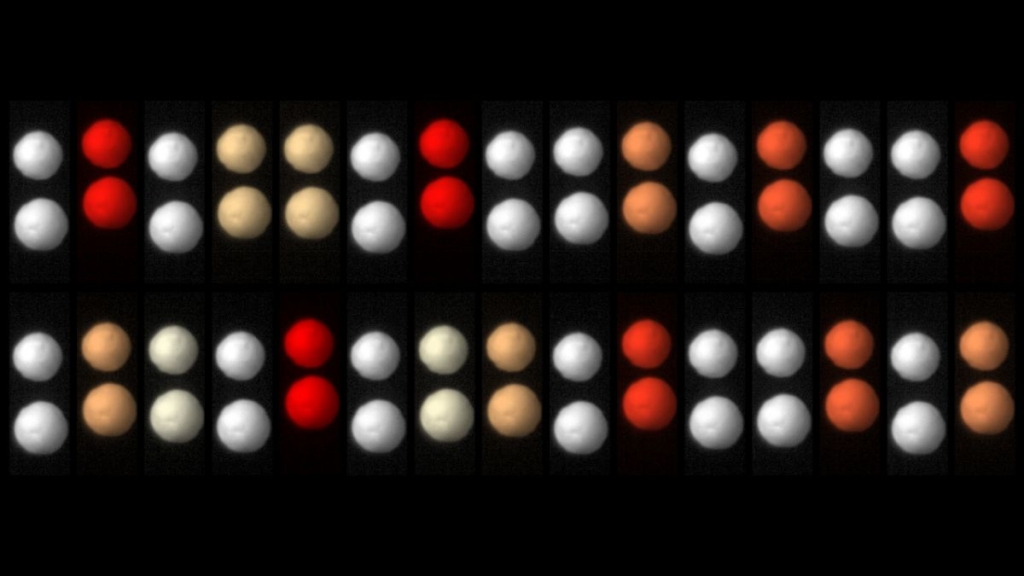
Scientists Have Created a Time Crystal You Can Literally Hold in Your Hand—Using Just Styrofoam and Speakers
In a stunning breakthrough that sounds more like science fiction than physics, researchers at New York University have demonstrated that time crystals—exotic quantum states once thought to exist only in the realm of complex quantum systems—can emerge from a setup as simple as a speaker array, polystyrene beads, and sound waves.
This discovery shatters assumptions about the complexity required to observe such phenomena, and opens the door to entirely new ways of studying non-reciprocal interactions in a tangible, macroscopic setting.
The research, led by NYU physicist David Grier alongside colleagues Mia Morrell and Leela Elliott, began as an investigation into how tiny objects interact through scattered sound waves. What they stumbled upon, however, was far more profound: a classical time crystal, spontaneously oscillating in time without any external driving force.
A time crystal is not a solid object, but a repeating pattern in time—much like how a spatial crystal repeats its atomic structure in space. The key difference? A time crystal oscillates at a frequency that emerges from the system itself, not from an external clock. It breaks time symmetry, meaning its behavior isn’t locked to a periodic input—it just… keeps going.
In the NYU experiment, millimeter-sized polystyrene beads were levitated in a standing sound wave generated by an array of speakers. These beads, slightly different in size and shape, interacted through the sound waves they scattered. Because of their size differences, the force each bead exerted on the other wasn’t equal—a hallmark of non-reciprocal interactions.
Under the right conditions, this imbalance caused the beads to oscillate in a stable, repeating pattern for hours—a hallmark of time crystal behavior. And here’s the kicker: this was achieved with just two beads, the smallest possible system to exhibit such behavior.
“It’s incredibly simple,” Grier said. “Time crystals are fascinating not only because of the possibilities, but also because they seem so exotic and complicated. Our system is remarkable because it’s incredibly simple.”
The implications are profound. While there’s no immediate practical application, the system offers a clean, accessible laboratory for studying non-reciprocal interactions—common in acoustics, optics, and even some biochemical systems in the human body. Could similar principles underlie biological rhythms? The question is tantalizing.
This discovery also democratizes access to cutting-edge physics. You don’t need a multi-million-dollar quantum computer or a particle accelerator to explore exotic states of matter. Sometimes, all you need is styrofoam, a subwoofer, and a bit of curiosity.
The findings have been published in Physical Review Letters, marking a pivotal moment in our understanding of time crystals and the surprising simplicity with which nature can manifest its most exotic behaviors.
#TimeCrystal #QuantumPhysics #NYU #ScienceBreakthrough #AcousticLevitation #Physics #NonReciprocalInteractions #SoundWaves #StyrofoamScience #MacroscopicQuantum #FutureOfPhysics #HoldItInYourHand #ScienceAlert
You can literally hold a time crystal in your hand now 🤯
Scientists just made quantum physics simple with styrofoam and speakers
This changes everything we thought we knew about time crystals
From quantum weirdness to your living room—this is next-level science
Who knew polystyrene could unlock the secrets of the universe?,


Leave a Reply
Want to join the discussion?Feel free to contribute!