
U.S. spot BTC ETFs see $1.1 billion in 3-day inflows, set for biggest week since mid-January
Bitcoin ETFs Surge with $1.1 Billion Inflows as U.S. Demand Returns After 40-Day Slump
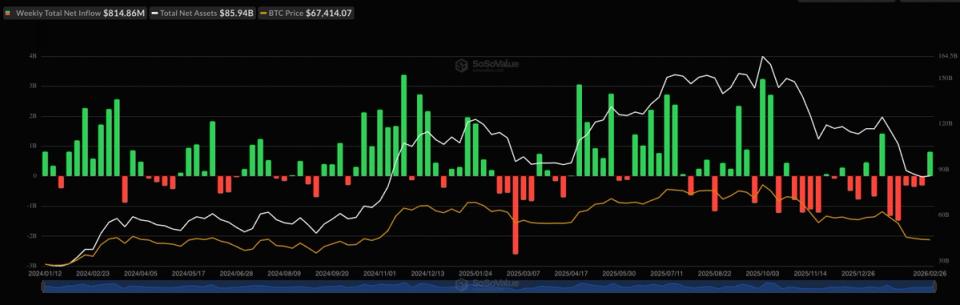
After enduring five consecutive weeks of net outflows, U.S. Bitcoin exchange-traded funds (ETFs) are staging a remarkable comeback, recording their strongest three-day inflow performance since mid-January. The renewed investor appetite signals a potential turning point in the crypto market, with institutional players re-entering the space at a time when Bitcoin’s price has been consolidating around the $65,000-$68,000 range.
According to data from SoSoValue, the U.S. spot Bitcoin ETFs attracted net inflows of $1.1 billion over three consecutive trading days, positioning the funds for their first positive weekly performance in over a month. Even accounting for Monday’s modest net outflow, the ETFs are projected to end the week roughly $815 million ahead—the largest weekly inflow since the week ending January 16, when they added $1.4 billion.
Leading this resurgence is BlackRock’s iShares Bitcoin Trust (IBIT), which alone accounted for more than half of the three-day inflows, drawing in approximately $652 million. The fund continues to dominate the space with its competitive fee structure and institutional-grade infrastructure, reinforcing BlackRock’s position as the market leader in crypto investment products.
Perhaps most notably, Grayscale’s Bitcoin Trust (GBTC), which has been hemorrhaging assets since the launch of competing ETFs in January 2024, posted its largest single-day inflow since converting from a trust structure to an ETF. This marks a significant reversal for GBTC, which has suffered from the highest fee among all spot Bitcoin ETFs at 1.5%, compared to BlackRock’s 0.25% and Fidelity’s 0.39%.
U.S. Demand Signal Turns Positive After Historic 40-Day Drought
The renewed inflows coincide with a critical shift in the Coinbase Premium Index, which turned positive after spending an unprecedented 40 consecutive days in negative territory. This metric, which measures the price difference between Bitcoin on Coinbase (accessible to U.S. institutional investors) and the broader global market, is widely regarded as a barometer of American institutional sentiment and flow patterns.
The 40-day negative streak was the longest on record and suggested that U.S. institutions were net sellers during that period, potentially contributing to Bitcoin’s roughly 45% decline from its October all-time high above $73,000. The index’s return to positive territory indicates that U.S. demand is resurging, with American institutions now willing to pay a premium for Bitcoin exposure.
Data from Checkonchain reveals that total Bitcoin holdings across U.S. spot ETFs have climbed to 1.29 million BTC, representing assets under management (AUM) that are now less than 10% below their October peak. This recovery in holdings is particularly impressive given that Bitcoin’s spot price remains approximately 45% below its record high, suggesting that investors are accumulating at these lower levels with an eye toward long-term appreciation.
CME Open Interest Decline Signals Outright Long Positions
Adding further credence to the narrative of returning institutional demand is the continued decline in open interest on the Chicago Mercantile Exchange (CME). Glassnode data shows CME Bitcoin futures open interest has fallen to 107,780 BTC, continuing a downward trend that began earlier this year.
This decline is significant because CME allows institutions to execute basis trades—simultaneously taking long positions in spot Bitcoin while shorting futures contracts to capture the spread between the two markets. The reduction in futures open interest suggests that these arbitrage positions are being unwound, and the ETF inflows are increasingly representing outright long positions rather than hedged trades.
The basis trade unwinding is particularly relevant because it indicates genuine bullish sentiment rather than purely technical positioning. When institutions are willing to hold unhedged Bitcoin exposure through ETFs, it suggests confidence in the asset’s medium-term trajectory rather than simply exploiting price discrepancies between markets.
Market Context and Price Action
Bitcoin has continued to trade within a relatively tight range this week, consolidating around the mid-$60,000 level after experiencing heightened volatility in recent months. The cryptocurrency’s ability to hold above $60,000 despite the 40-day period of negative U.S. demand signals underlying support from other market participants, including retail investors and international institutions.
The current price action suggests a market in transition, with sellers who emerged during the negative demand period potentially exhausted, while buyers are beginning to re-enter at what they perceive as attractive levels. The convergence of positive ETF flows, the returning Coinbase Premium, and declining CME open interest creates a technical setup that many analysts view as bullish for the medium term.
Implications for the Broader Crypto Ecosystem
The resurgence in Bitcoin ETF inflows has implications that extend beyond the direct beneficiaries. As the largest and most liquid crypto investment vehicle, Bitcoin often serves as a gateway for institutional capital entering the digital asset space. Renewed confidence in Bitcoin products could eventually spill over into other crypto assets and investment vehicles.
Moreover, the performance of these ETFs is being closely watched by regulators and traditional financial institutions considering their own crypto product offerings. A sustained period of positive flows could accelerate the development of new crypto investment products and potentially influence regulatory decisions regarding the broader digital asset ecosystem.
The current momentum also provides a counterpoint to narratives suggesting that the ETF product cycle had peaked following the initial surge of interest in early 2024. Instead, it suggests that these vehicles may be establishing themselves as core components of institutional crypto allocation strategies, with flows ebbing and flowing based on market conditions rather than representing a one-time adoption event.
Tags
Bitcoin ETF inflows, Grayscale GBTC recovery, BlackRock IBIT dominance, Coinbase Premium Index, U.S. institutional demand, CME basis trade unwinding, Bitcoin price consolidation, crypto market sentiment, institutional crypto adoption, digital asset investment trends, Bitcoin holdings recovery, ETF AUM growth, crypto market technical analysis, institutional Bitcoin exposure, Bitcoin ETF product cycle
Viral Sentences
Bitcoin ETFs are back with a vengeance, raking in $1.1 billion in three days! U.S. demand returns after 40-day drought as Coinbase Premium flips positive. BlackRock’s IBIT dominates with $652 million inflow while Grayscale’s GBTC finally sees daylight. Institutions are going long on Bitcoin, unwinding basis trades as CME open interest plunges. Bitcoin holdings near October peaks despite 45% price drop from ATH. The crypto comeback is real—Bitcoin ETFs are the canary in the institutional investment coal mine!
,

Leave a Reply
Want to join the discussion?Feel free to contribute!