
Vykar is a New Open Source Backup Tool That’s Faster Than Borg, Restic, and Kopia
Vykar: The Rust-Powered Backup Revolution That’s Faster Than Borg and Restic—But Should You Trust It?
In the ever-evolving world of Linux data protection, a new contender has emerged from the shadows, promising to revolutionize how we think about backups. Meet Vykar, the open-source encrypted backup tool that’s making waves with its blistering speed and modern architecture—but comes with a warning sticker that reads “proceed with caution.”
The Linux backup landscape has long been dominated by stalwarts like BorgBackup and Restic, tools that have earned their stripes through years of reliable service. But as with any mature technology, the question inevitably arises: can something newer, built with modern programming languages and contemporary design principles, outperform the old guard?
Enter Vykar, developed by the team behind BorgBase, the managed repository hosting service that’s been a mainstay for Borg and Restic users for nearly a decade. This isn’t just another backup tool—it’s a statement of intent, a demonstration that the Rust programming language can deliver enterprise-grade performance in the data protection space.
What Makes Vykar Different?
At its core, Vykar is an encrypted, deduplicated backup solution written in Rust and released under the GPL-3.0 license. But calling it “just another backup tool” would be a profound understatement. Vykar represents a philosophical departure from existing solutions, drawing inspiration from BorgBackup and Borgmatic while forging its own path with a proprietary repository format.
The most striking aspect of Vykar’s design is its configuration philosophy. Everything—from repositories and source directories to encryption settings and retention policies—is defined in a single YAML file. This unified approach eliminates the configuration sprawl that plagues many backup solutions, where settings are scattered across multiple files and interfaces.
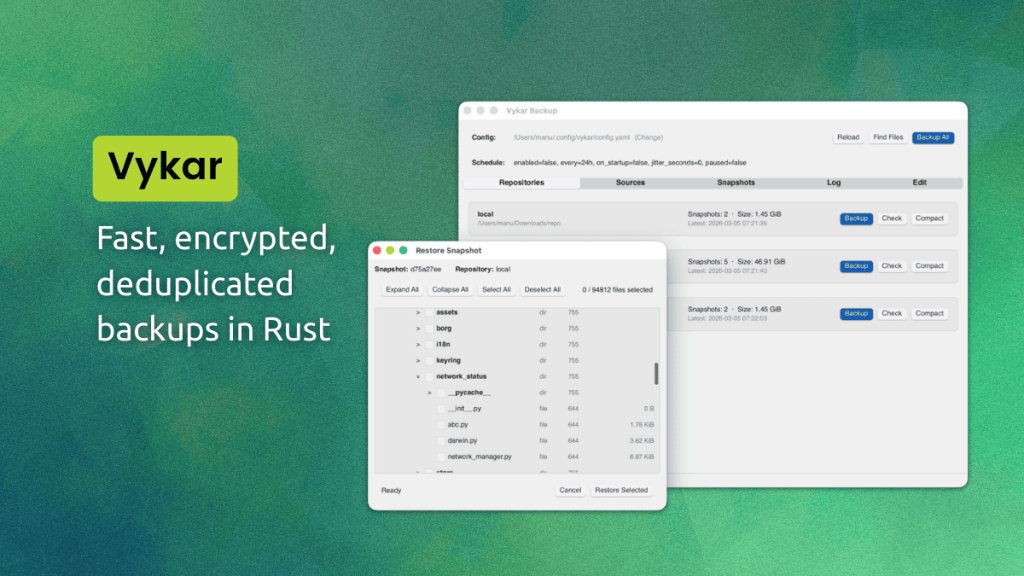
But Vykar’s ambitions extend far beyond configuration elegance. The tool boasts a comprehensive feature set that includes scheduling via the vykar daemon, deduplication using FastCDC algorithms, compression support with LZ4 or Zstandard, and a desktop GUI with system tray integration. Perhaps most impressively, Vykar includes a built-in WebDAV server for browsing and restoring snapshots—a feature that typically requires third-party tools in other ecosystems.
The Encryption Question
Security-conscious users will appreciate Vykar’s encryption implementation, which supports AES-256-GCM or ChaCha20-Poly1305 (with automatic selection) and Argon2id key derivation. The tool also supports concurrent multi-client backups, allowing multiple machines to write to the same repository simultaneously—a feature that could be a game-changer for organizations managing distributed backup infrastructure.
However, the encryption story comes with an important caveat: Vykar uses its own repository format, making it incompatible with existing Borg or Restic repositories. This means users considering Vykar must be prepared for vendor lock-in, at least within the Vykar ecosystem.
Performance That Demands Attention
Where Vykar truly shines is in its performance benchmarks—numbers that, if accurate, would make it the fastest backup solution in its class. The project’s website presents a compelling comparison against Borg, Restic, Rustic, and Kopia, tested against a 49 GiB dataset containing 367,000 files.
The results are eye-popping: Vykar completed its backup in just 61 seconds, compared to Rustic’s 313 seconds, Borg’s 268 seconds, Restic’s 138 seconds, and Kopia’s 85 seconds. Restore times follow a similar pattern, with Vykar finishing in 69 seconds versus 82 for Rustic, 225 for Borg, 130 for Restic, and 132 for Kopia.
CPU efficiency shows the clearest advantage, with Vykar using just 234 CPU seconds for backup compared to Borg’s 250, Restic’s 696, Rustic’s 728, and Kopia’s 428. This represents a potential 3x improvement over Restic and nearly 4x over Rustic in terms of computational efficiency.
The Memory Trade-off
However, performance comes with costs, and in Vykar’s case, that cost is memory usage. During backup operations, Borg uses just 236 MB compared to Vykar’s 623 MB. Restic is also more memory-efficient at 327 MB. This means Vykar is trading approximately 2.5x more RAM for its speed advantages—a consideration that could be significant on memory-constrained systems or when backing up extremely large datasets.
Repository sizes across all five tools are remarkably similar, ranging from 19.7 to 19.9 GB under equivalent Zstd compression settings. This suggests that despite Vykar’s performance advantages, deduplication efficiency remains roughly comparable across the board—meaning users aren’t sacrificing storage efficiency for speed.
The Installation Experience
Getting started with Vykar is refreshingly straightforward. The installation process is a single command: curl -fsSL https://vykar.borgbase.com/install.sh | sh. Pre-built binaries are available for Linux (x86_64 and aarch64, both glibc and musl), macOS (Apple Silicon), and Windows on the GitHub releases page.
Vykar supports four storage backends: local filesystem, S3-compatible object storage (any provider works), SFTP, and a dedicated REST server. This flexibility means users can choose the storage solution that best fits their needs, whether that’s local storage for quick access, cloud storage for off-site redundancy, or specialized backup servers.
The GUI Advantage
One of Vykar’s most compelling features is its desktop GUI, vykar-gui, which ships as a first-party component. This is a significant departure from the Borg ecosystem, where users typically rely on third-party tools like Vorta for desktop interfaces, or Restic’s Backrest, which is also community-maintained.
The Vykar GUI reads directly from vykar.yaml, runs backups on demand, and can sit in the system tray running scheduled backups in the background. This integrated approach provides a more cohesive user experience and reduces the complexity of managing backup operations.
The Elephant in the Room: Production Readiness
Here’s where we need to pump the brakes. The developers themselves explicitly state that Vykar is not recommended for production use. This is a critical caveat that potential users must weigh carefully. While the performance numbers are impressive and the feature set is comprehensive, Vykar is still a relatively new project without the battle-tested reliability of its more established competitors.
The warning suggests that while Vykar may be suitable for experimentation, testing, or non-critical data protection scenarios, organizations with mission-critical data should exercise extreme caution before adopting it as their primary backup solution.
Who Should Consider Vykar?
Vykar represents an intriguing option for several user profiles:
Tech enthusiasts and early adopters who want to experiment with cutting-edge backup technology and don’t mind dealing with potential instability or incompatibilities.
Developers and system administrators looking for a high-performance backup solution for non-critical data or testing environments.
Organizations with specific performance requirements that might justify the trade-offs in memory usage and the lack of production-ready status.
Users frustrated with the complexity or performance of existing backup solutions who are willing to accept some risk for potential gains.
The Bottom Line
Vykar is undeniably impressive on paper. Its Rust foundation promises memory safety and performance, its unified configuration approach simplifies management, and its benchmark numbers suggest it could be the fastest backup tool available. The inclusion of a first-party GUI and WebDAV server addresses common pain points in the backup ecosystem.
However, the explicit “not for production use” warning cannot be ignored. This isn’t a mature, battle-tested solution—it’s an ambitious new entrant that’s still proving itself. For users with critical data or those who need absolute reliability, the established tools (Borg, Restic, Timeshift, Déjà Dup) remain the safer choices.
For everyone else, Vykar represents an exciting glimpse into the future of backup technology. It demonstrates what’s possible when modern programming languages and contemporary design principles are applied to traditional data protection challenges. Whether it will mature into a production-ready solution remains to be seen, but it’s certainly a project worth watching.
The backup landscape is about to get a lot more interesting.
#Vykar #LinuxBackup #RustProgramming #DataProtection #OpenSource #BorgBackup #Restic #BackupSolutions #SystemAdministration #TechInnovation #PerformanceBenchmark #EncryptedBackup #Deduplication #YAMLConfiguration #WebDAV #SystemTray #MemoryEfficiency #CPUPerformance #StorageOptimization #TechNews
“The future of backup technology is here, and it’s written in Rust!”
“Vykar isn’t just fast—it’s blazing fast, but can you trust it with your data?”
“3x faster than Restic, but uses 2.5x more memory. The performance trade-offs are real.”
“First-party GUI? Built-in WebDAV? Vykar is redefining what a backup tool can be.”
“Warning: Not for production use. But wow, those benchmarks!”
“Linux backup wars just got a new contender, and it’s packing serious heat.”
“The BorgBase team strikes again with Vykar, their Rust-powered backup revolution.”
“Encrypted, deduplicated, and blazing fast—Vykar checks all the boxes, but should you check it out?”
“Memory usage is the price of speed in Vykar’s backup performance equation.”
“Vykar’s unified YAML configuration could be the simplicity we’ve been waiting for in backup management.”,


Leave a Reply
Want to join the discussion?Feel free to contribute!