
Watch Kanzi the bonobo pretend to have a tea party
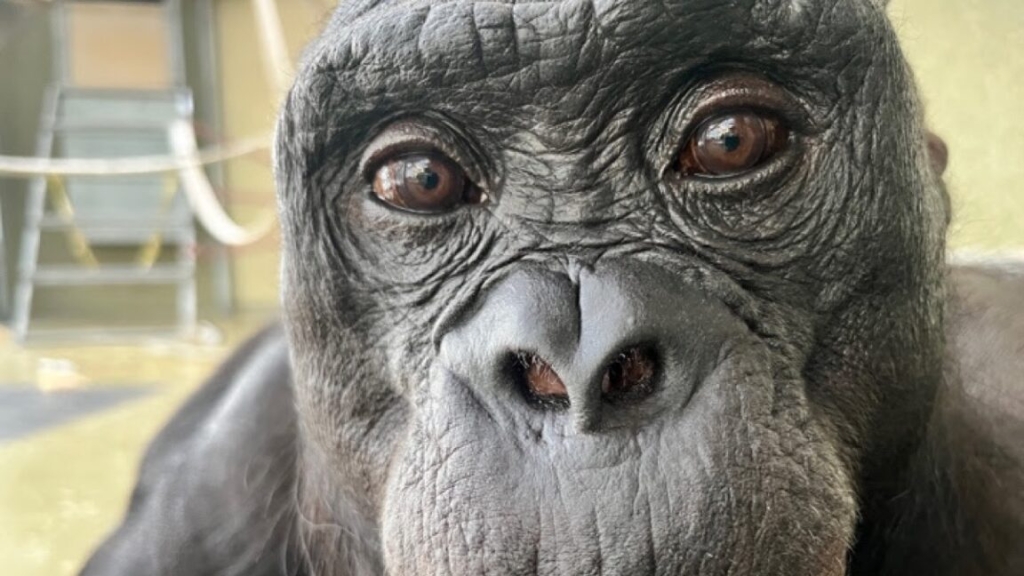
Bonobo Breakthrough: Kanzi’s “Imaginary Juice” Test Shakes Up Primate Cognition Research
In a groundbreaking experiment that’s sending ripples through the scientific community, a 43-year-old bonobo named Kanzi has demonstrated what researchers are calling “compelling evidence” of pretend play in non-human primates. The study, published in a leading primatology journal, challenges long-held assumptions about animal cognition and suggests that our closest evolutionary relatives may possess far more sophisticated mental capabilities than previously thought.
The Long Road to Recognition
For decades, scientists have debated whether animals—particularly our primate cousins—are capable of imagination and pretend play. Previous studies attempting to demonstrate such abilities have often been met with skepticism, with critics suggesting that animals might simply be responding to subtle behavioral cues like eye movements or body language rather than truly understanding the concept of make-believe.
The skepticism is understandable. In the animal kingdom, survival often depends on reading real, tangible signals rather than engaging in abstract thought. A monkey that spends too much time imagining scenarios rather than responding to actual threats wouldn’t last long in the wild. This practical reality has led many researchers to assume that complex imaginative abilities are uniquely human traits.
Meet Kanzi: The Bonobo Who’s Changing Everything
Enter Kanzi, a remarkable bonobo who resides at the Ape Initiative, a research facility dedicated to understanding primate cognition. What makes Kanzi special isn’t just his age—43 years in bonobo years is quite senior—but his extraordinary communication abilities. This bonobo has mastered responding to verbal prompts and can communicate using a lexigram system containing over 300 symbols.
But Kanzi’s impressive vocabulary is just the beginning. Researchers had previously observed what appeared to be spontaneous instances of pretend play in his behavior. These anecdotal observations sparked the idea for a rigorous scientific test that would either confirm or refute the hypothesis that Kanzi could engage in genuine imaginative thinking.
The Ingenious “Imaginary Juice” Experiment
The research team, led by Dr. Christopher Krupenye, designed three distinct experiments, each consisting of 18 trials. The centerpiece was what they called the “imaginary juice” test—a deceptively simple setup that would prove to be a cognitive minefield for the bonobo.
Here’s how it worked: A researcher would begin by saying, “Kanzi, let’s play a game! Let’s find the juice!” The scientist would then place two empty, transparent cups on a table. Using an equally empty, transparent pitcher, they would pretend to pour “juice” into one of the cups. Then, in a crucial twist, they would pretend to pour the “juice” back from that cup into the pitcher, placing the pitcher under the table. Finally, they would ask, “Kanzi, where’s the juice?” and record which cup Kanzi pointed to first.
The Cognitive Challenge
This experiment was brilliantly designed to eliminate alternative explanations. If Kanzi were simply tracking reality—that both cups were actually empty—he should have chosen randomly between the two options, essentially guessing at chance level. If he were responding to behavioral cues or stimulus enhancement (perhaps being drawn to the cup that had been “emptied”), he should have selected the incorrect cup more often than not.
But if Kanzi could actually represent the pretend juice in his mind—if he understood that the juice existed in his imagination even though it wasn’t physically present—he should consistently choose the cup that still “contained” the imaginary liquid, the one that hadn’t been “poured back” into the pitcher.
The Results That Stunned Scientists
Kanzi’s performance was nothing short of remarkable. Out of 50 trials across multiple sessions, he correctly identified the cup containing the “imaginary juice” 34 times—a stunning 68 percent success rate. This far exceeds what would be expected by chance alone and demonstrates a clear pattern of understanding.
“The results were unequivocal,” the research team reported. “Kanzi consistently chose the cup that had not been ’emptied,’ indicating that his choices were guided by his representation of the pretend juice rather than by the actual physical properties of the cups or any behavioral cues from the experimenter.”
What This Means for Animal Cognition
This experiment represents a significant breakthrough in our understanding of animal minds. It suggests that bonobos—and potentially other primates—possess the cognitive ability to hold representations of things that don’t physically exist, a cornerstone of imagination and pretend play.
The implications extend far beyond academic curiosity. If bonobos can engage in pretend play, it suggests they have a theory of mind—the ability to understand that others have thoughts, beliefs, and intentions that may differ from their own. This is a cognitive capacity that was long thought to be uniquely human.
The Broader Context
Kanzi isn’t the first animal to demonstrate impressive cognitive abilities, but this study is particularly significant because it addresses pretend play specifically—a complex mental process that involves holding two contradictory realities in mind simultaneously: the knowledge that something is not real, while treating it as if it were real.
Previous research has shown that great apes can use tools, understand symbols, and even demonstrate some level of self-awareness. But the ability to engage in sustained pretend play suggests a level of cognitive sophistication that brings us closer to understanding the evolutionary origins of human imagination.
Looking Forward
The research team plans to conduct similar experiments with other bonobos and potentially other primate species to determine how widespread this ability might be. They’re also interested in exploring whether pretend play in primates serves similar developmental functions as it does in human children—helping to develop social skills, problem-solving abilities, and creativity.
For Kanzi, the experiments appear to have been engaging and stimulating. The bonobo showed clear enthusiasm during the trials and seemed to understand that he was participating in a game—another indication of his sophisticated cognitive abilities.
This study doesn’t just tell us about bonobos; it tells us something profound about the nature of intelligence and consciousness in the animal kingdom. As we continue to uncover the remarkable mental capabilities of our evolutionary cousins, we may need to revise our understanding of what makes human cognition unique.
The line between human and animal cognition may be far more blurred than we ever imagined, and Kanzi the bonobo is helping to redraw that line in ways that could fundamentally change how we view our place in the natural world.
Tags
Kanzi bonobo pretend play animal cognition primate intelligence imaginary juice experiment Ape Initiative research breakthrough cognitive abilities theory of mind great apes imagination science discovery viral animal behavior
Viral Sentences
Kanzi the bonobo just proved animals can imagine things that aren’t real 🤯
This 43-year-old ape is smarter than we thought possible
The “imaginary juice” test that’s changing everything we know about animal minds
Bonobos might be more like us than we ever realized
Science just got a whole lot more interesting
Kanzi’s 68% success rate proves he’s not just guessing
The experiment that proves animals have imagination
Groundbreaking research that challenges everything
Kanzi is the Einstein of the bonobo world
This study will make you question everything about animal intelligence
The bonobo who can play make-believe better than some humans
Science confirms what animal lovers have known all along
Kanzi’s lexigram skills are just the beginning
The cognitive leap that bridges humans and apes
This research could change how we treat primates forever
Kanzi just joined the exclusive club of animals that can pretend
The experiment design so clever it eliminates all doubt
What Kanzi’s success means for evolution of imagination
The bonobo who sees juice that isn’t there
Science finally proves animals have rich inner lives
,


Leave a Reply
Want to join the discussion?Feel free to contribute!