
Watch the Atlas robot’s bloopers before it finally nails a challenging move
Boston Dynamics’ Atlas Robot: From Backflips to the Factory Floor
In a dazzling display of mechanical mastery, Boston Dynamics has once again pushed the boundaries of what humanoid robots can achieve. The company’s latest video showcasing its Atlas robot performing a series of athletic feats has taken the internet by storm, offering both breathtaking successes and refreshingly honest failures that humanize this technological marvel.
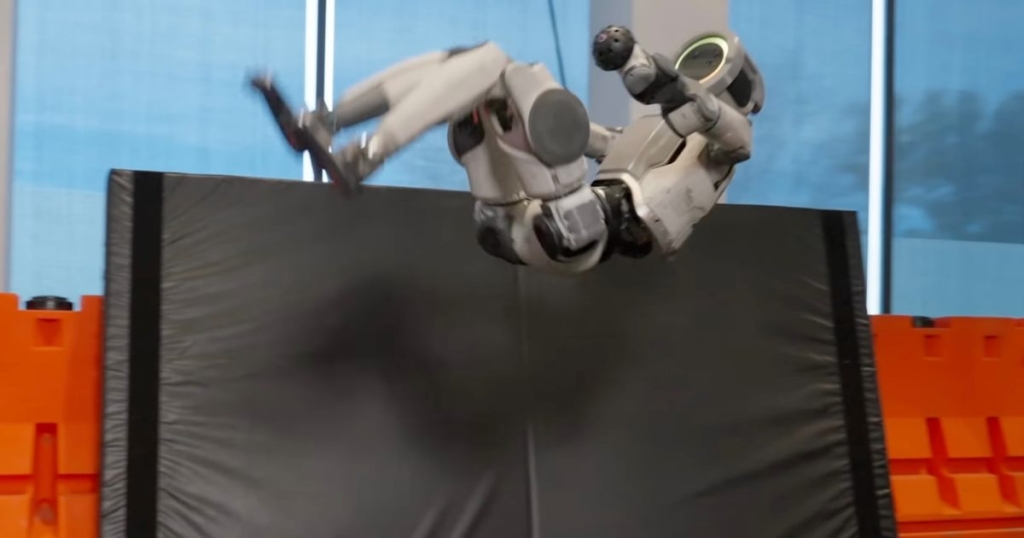
The video opens with Atlas executing a cartwheel followed by a backflip with such precision that it almost feels like watching an Olympic gymnast in slow motion. The robot’s movements are fluid, controlled, and remarkably human-like, demonstrating the extraordinary progress Boston Dynamics has made in robotic mobility and balance.
But what makes this particular showcase stand out is the transparency Boston Dynamics has embraced. Rather than presenting only flawless performances, the video includes several clips of Atlas attempting the same maneuvers and failing spectacularly. We see the robot crumple to the ground after a botched backflip, trip while running, and keel over to the amusement of the testing team. This honest portrayal not only makes the technology more relatable but also highlights the complexity of the challenges these engineers are tackling.
The most impressive moment comes at the 1:06 mark, where Atlas performs a backflip that doesn’t land perfectly. Instead of collapsing, the robot demonstrates its advanced stabilization systems by quickly adjusting its posture and recovering its balance in a manner reminiscent of a gymnast correcting a slightly off landing. This ability to adapt mid-movement represents a significant leap forward in robotic control systems.
Behind these athletic achievements lies months of collaboration between Boston Dynamics engineers and experts at the Robotics and AI Institute. Together, they’ve been working to perfect Atlas’s full-body control and mobility, focusing on developing systems that can handle complex, dynamic environments with the grace and adaptability of a human.
While these gymnastic abilities might seem like mere spectacle, they serve a crucial purpose in developing the fundamental capabilities needed for real-world applications. Balance, coordination, and the ability to recover from unexpected situations are essential traits for robots operating in unpredictable environments like warehouses, factories, and potentially even disaster zones.
The long-term vision for Atlas extends far beyond entertainment or demonstration purposes. Boston Dynamics aims to deploy these humanoid robots in workplace settings where their human-like form factor offers distinct advantages. Unlike specialized industrial robots that excel at repetitive tasks in controlled environments, humanoid robots like Atlas can navigate spaces designed for humans, use standard tools and equipment, and adapt to changing conditions.
This vision is already materializing. A previous Boston Dynamics video demonstrated Atlas using artificial intelligence and machine learning to perform workplace tasks autonomously, including the competent handling and sorting of engine covers between containers. The robot operated without teleoperation, making decisions and executing tasks independently based on its programming and sensory input.
The practical applications are becoming increasingly concrete. Recently, Boston Dynamics revealed plans to deploy Atlas robots at a U.S. facility operated by Hyundai, the company’s primary investor. In the coming years, these humanoid robots will assist in assembling vehicles, marking one of the first large-scale commercial deployments of such advanced robotics technology.
This partnership with Hyundai represents a significant milestone in the evolution of humanoid robotics. While industrial robots have been a staple of automotive manufacturing for decades, they’ve typically been specialized machines designed for specific tasks. Atlas represents a different approach—a general-purpose robot capable of performing a variety of tasks that might require human-like dexterity, perception, and adaptability.
The implications of this technology extend far beyond the automotive industry. Warehouses, construction sites, hospitals, and even homes could eventually benefit from robots that can navigate human environments with ease. The ability to perform complex physical tasks while maintaining balance and recovering from mistakes makes Atlas particularly well-suited for environments where conditions can change rapidly and unpredictably.
However, the path to widespread deployment is still fraught with challenges. While Atlas can perform impressive physical feats, it still requires significant infrastructure and support to operate effectively. Battery life, processing power, safety systems, and the ability to handle unexpected situations remain areas requiring continued development.
Moreover, the economic and social implications of humanoid robots in the workplace are complex and multifaceted. While these robots could potentially take on dangerous or repetitive tasks, reducing workplace injuries and freeing humans for more creative or supervisory roles, they also raise questions about job displacement and the changing nature of work.
Boston Dynamics’ approach of demonstrating both successes and failures provides a more realistic view of the current state of humanoid robotics. It acknowledges that while the technology has made extraordinary progress, there’s still a significant journey ahead before robots like Atlas become commonplace in our daily lives.
The viral nature of these videos speaks to our collective fascination with robots that can move and behave like humans. Each new demonstration sparks discussions about the future of robotics, artificial intelligence, and the relationship between humans and machines. The combination of impressive capabilities and honest portrayals of limitations creates a narrative that’s both aspirational and grounded in reality.
As Boston Dynamics continues to refine Atlas and explore its commercial applications, we’re witnessing the early stages of what could be a transformative technology. The robot’s ability to perform complex physical tasks, adapt to changing conditions, and operate autonomously represents a convergence of advancements in robotics, artificial intelligence, and materials science.
The journey from backflips to factory floors illustrates how fundamental research in robotics can lead to practical applications that reshape industries. What began as a demonstration of athletic prowess is evolving into a tool that could revolutionize how we approach manufacturing, logistics, and potentially many other fields.
As we watch Atlas continue to evolve, we’re not just seeing a robot learn new tricks—we’re witnessing the gradual realization of a vision where intelligent machines work alongside humans, enhancing our capabilities and taking on tasks that are dangerous, difficult, or simply tedious. The future of humanoid robotics is unfolding before our eyes, one backflip at a time.
Tags
Atlas robot, Boston Dynamics, humanoid robotics, backflip, cartwheel, AI robotics, machine learning, autonomous robots, Hyundai partnership, factory automation, robotics innovation, viral robot video, technological advancement, robotics transparency, workplace robots, robotics future, artificial intelligence, robotic mobility, industrial robotics, CES 2026
Viral Phrases
“This robot just did a backflip and the internet can’t handle it”
“Boston Dynamics shows Atlas failing and it’s actually inspiring”
“The future of work is here and it does gymnastics”
“Watch this robot recover from a bad landing like a pro athlete”
“Atlas is coming to a factory near you”
“The robot that can do what humans can’t (and some things we can)”
“When your co-worker is a humanoid robot from Boston Dynamics”
“This isn’t CGI, it’s the real future of robotics”
“The most honest robot demo you’ll ever see”
“Atlas proves that failure is just part of the learning process”
“The robot that’s learning to work alongside humans”
“Boston Dynamics just changed the game again”
“Watch Atlas sort engine parts like a pro”
“The backflip that launched a thousand tweets”
“Robotics transparency at its finest”
“When robots get more coordinated than most humans”
“The athletic robot that’s headed to the assembly line”
“Atlas: From viral videos to real-world applications”
“The robot that laughs with you when it falls”
“Breaking: Robots are officially cooler than humans”
,

Leave a Reply
Want to join the discussion?Feel free to contribute!