
Weakening ice shelf has caused crucial Antarctic glacier to accelerate
Antarctic Glacier’s Rapid Acceleration Signals Potential Climate Tipping Point
In a development that has sent shockwaves through the scientific community, researchers have documented an alarming acceleration in the movement of Pine Island Glacier, one of Antarctica’s most critical ice formations. The findings, published in a recent study led by Sarah Wells-Moran at the University of Chicago, suggest that this massive glacier may be entering a phase of irreversible decline with profound implications for global sea levels.
A Century of Change in Six Years
The numbers are staggering. Between 2017 and 2023 alone, Pine Island Glacier’s velocity increased by 20%, surging from 4 kilometers per year to nearly 5 kilometers per year. To put this in perspective, that’s a 113% increase since 1973. This glacier, already the fastest-flowing in Antarctica, is now moving at unprecedented speeds.
What makes this acceleration particularly concerning is its timing. The most dramatic changes have occurred in just the past six years, suggesting that the glacier may have crossed a critical threshold. As Wells-Moran and her colleagues note, this rapid change appears to be driven by the thinning and fracturing of the ice shelf that normally acts as a buttress, holding back the inland ice.
The Critical Role of Ice Shelves
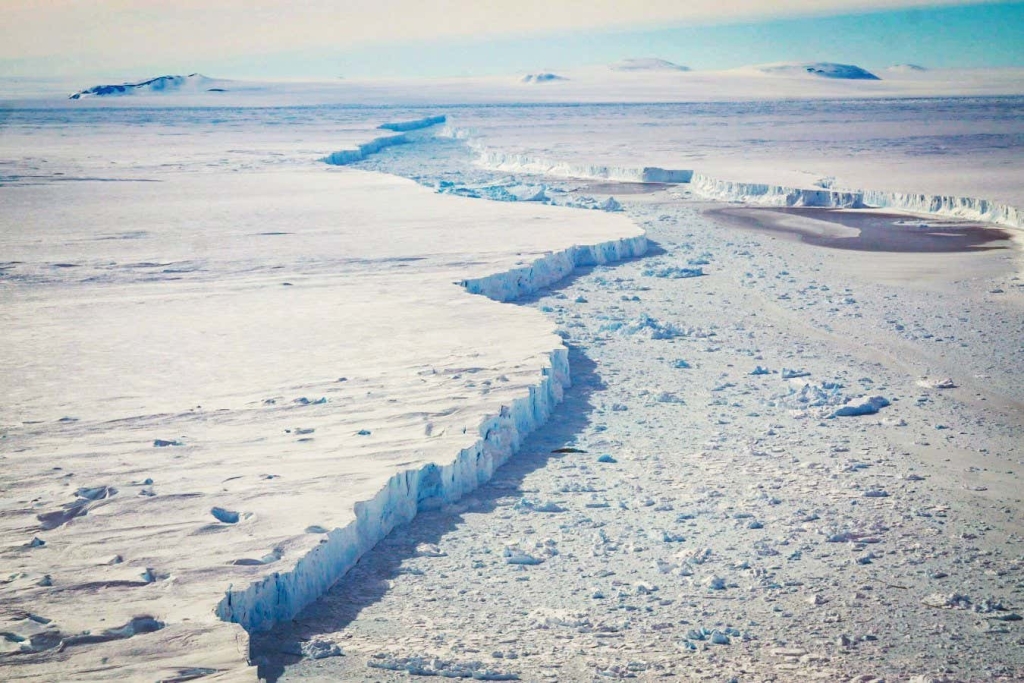
Pine Island Glacier’s floating ice shelf serves as a crucial barrier, buttressing an amount of ice equivalent to 51 centimeters of potential sea-level rise. This natural barrier has been deteriorating rapidly as warmer seawater penetrates beneath the shelf, causing it to thin and fracture. The sides of the ice shelf have become detached from surrounding ice, a process the researchers describe as the “unzipping” of the shelf’s margins.
“The ice shelf now provides negligible buttressing to the ice upstream,” the research team concluded, a statement that carries ominous implications for the stability of the entire West Antarctic ice sheet.
A Domino Effect in Antarctica
The instability of Pine Island Glacier is particularly worrying because of its relationship to the neighboring Thwaites Glacier, ominously nicknamed the “Doomsday Glacier.” Together, these two massive ice formations hold enough frozen water to raise global sea levels by more than 3 meters if they were to melt completely.
The West Antarctic ice sheet, of which these glaciers are key components, contains enough ice to raise global sea levels by 5.3 meters if fully melted. The accelerating movement of Pine Island Glacier suggests that this process may already be underway.
Expert Analysis: Beyond Surface Observations
Sue Cook from the University of Tasmania emphasizes that the acceleration cannot be explained by surface calving alone. “Most likely the cause is increased damage in the shear margins of the glacier,” she explains. “This study helps to confirm that mechanism.”
Ted Scambos from the University of Colorado adds another dimension to the concern, suggesting that warm ocean water may be reaching the margins of the ice shelf where it extends into Pine Island Bay, a glacial-carved fjord. “With the loss of the ice shelf, it is likely that ocean circulation in the fjord will speed up, and the intensity of the circulation near the point where the glacier is grounded on the bedrock will increase,” Scambos warns.
Global Implications
Nerilie Abram from the Australian Antarctic Division underscores the global significance of these findings. “There is no doubt that ice loss from this region will continue to impact the world’s coastlines over the coming decades and centuries,” she states. The study demonstrates not just how much Pine Island ice shelf is failing, but how quickly this failure is occurring.
The acceleration of Pine Island Glacier represents more than just a local phenomenon—it’s a potential harbinger of broader changes across Antarctica. As one of the continent’s most significant contributors to sea-level rise, its destabilization could trigger a cascade of effects throughout the West Antarctic ice sheet.
The Bigger Picture
This research comes at a time when Antarctic ice loss is accelerating globally. The changes observed at Pine Island Glacier align with broader patterns of warming in the Southern Ocean and increased basal melting of ice shelves throughout West Antarctica. The study’s findings reinforce concerns that the region may be approaching—or may have already passed—critical tipping points in the climate system.
The implications extend far beyond Antarctica. Rising sea levels threaten coastal communities worldwide, from small island nations to major metropolitan areas. The acceleration of Pine Island Glacier adds urgency to efforts to understand and mitigate climate change, as it suggests that some of the most dramatic impacts may be unfolding faster than previously anticipated.
Conclusion
The rapid acceleration of Pine Island Glacier represents a critical development in our understanding of Antarctic ice dynamics and global sea-level rise. As scientists continue to monitor this and other vulnerable ice formations, the need for comprehensive climate action becomes increasingly clear. The “unzipping” of Antarctica’s ice shelves may be one of the most visible and consequential manifestations of our warming planet.
Tags: Antarctic glacier, Pine Island Glacier, climate change, sea level rise, ice shelf collapse, West Antarctic ice sheet, global warming, Doomsday Glacier, Thwaites Glacier, ice dynamics, climate tipping point, polar research, environmental science, oceanography, glaciology
Viral phrases: Antarctica’s ticking time bomb, The glacier that could drown cities, Climate change’s ice apocalypse, When Antarctica’s ice shelf “unzips”, The 5.3-meter sea level threat, Antarctica’s Doomsday scenario, The glacier racing toward catastrophe, Ice shelf failure accelerates, Antarctica’s climate time bomb ticking faster, The melting that could reshape coastlines, Scientists sound alarm on Antarctic ice, The glacier that’s moving too fast, Antarctica’s ice shelf “unzipping” phenomenon, Climate change’s ice shelf collapse, The glacier that could raise seas by meters, Antarctica’s accelerating ice loss, The ice shelf holding back catastrophe, When Antarctica’s glaciers go rogue, The climate tipping point in Antarctica, Antarctica’s ice on the brink
,

Leave a Reply
Want to join the discussion?Feel free to contribute!