
Webb Maps Uranus’ Upper Atmosphere and Finds a Magnetic Surprise
Webb Maps Uranus’ Upper Atmosphere and Finds a Magnetic Surprise
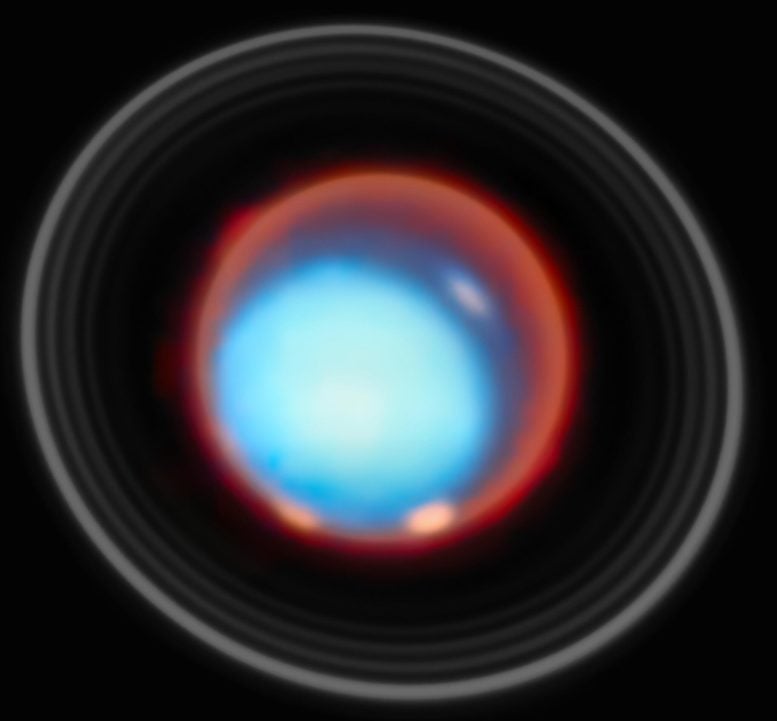
In a groundbreaking revelation that is sending shockwaves through the astronomical community, NASA’s James Webb Space Telescope (JWST) has unveiled the first-ever 3D map of Uranus’s upper atmosphere. This unprecedented achievement not only sheds light on the planet’s complex atmospheric layers but also uncovers a series of magnetic surprises that challenge our understanding of the ice giant.
Uranus, the seventh planet from the Sun, has long been a subject of fascination due to its unique tilt and enigmatic characteristics. However, the latest findings from JWST have taken our knowledge of this distant world to new heights. The international team of astronomers, led by Dr. Emma Wilson of the University of Leicester, has meticulously tracked how temperatures and electrically charged particles vary with altitude, offering a clearer and more detailed picture of the conditions in Uranus’s upper atmosphere.
One of the most striking discoveries is the presence of wild and dynamic auroras, far more intense and complex than previously imagined. These auroras, caused by the interaction of solar wind with Uranus’s magnetic field, paint the planet’s upper atmosphere with vibrant hues of ultraviolet light. The 3D mapping has revealed that these auroras are not confined to the poles, as is the case with Earth, but are distributed across the planet in a manner that suggests a highly irregular magnetic field.
Speaking about the findings, Dr. Wilson stated, “Uranus continues to surprise us. The auroras we’ve observed are not only more widespread but also more energetic than we anticipated. This indicates that the planet’s magnetic field is far more complex and dynamic than we previously thought.”
The 3D map also highlights the planet’s ongoing cooling process. Despite being billions of years old, Uranus is still radiating heat into space, a phenomenon that has puzzled scientists for decades. The new data suggests that this cooling is not uniform across the planet, with certain regions of the upper atmosphere cooling at a faster rate than others. This uneven cooling could be linked to the planet’s unique tilt, which causes extreme seasonal variations and influences atmospheric circulation patterns.
Another intriguing aspect of the study is the detection of electrically charged particles at various altitudes. These particles, which include ions and electrons, play a crucial role in shaping the planet’s magnetic environment. The 3D map has revealed that the distribution of these particles is highly variable, with some regions showing a higher concentration than others. This variability could be a key factor in understanding the planet’s magnetic field and its interaction with the solar wind.
The implications of these findings extend beyond Uranus. As Dr. Wilson explained, “Understanding the dynamics of Uranus’s atmosphere and magnetic field can provide valuable insights into the behavior of other ice giants in our solar system and beyond. It could also help us refine our models of planetary formation and evolution.”
The James Webb Space Telescope, with its advanced infrared capabilities, has proven to be an invaluable tool in this research. Its ability to peer through the thick haze of Uranus’s atmosphere and capture detailed images in 3D has opened up new avenues for exploration. The telescope’s precision and sensitivity have allowed astronomers to detect subtle changes in temperature and particle distribution, providing a level of detail that was previously unattainable.
As the scientific community digests these findings, the excitement is palpable. Uranus, once considered a relatively quiet and unremarkable planet, is now emerging as a dynamic and complex world with a magnetic personality all its own. The 3D map produced by JWST is not just a scientific milestone; it is a testament to human ingenuity and our relentless quest to understand the cosmos.
In the coming months, the team plans to conduct further observations to delve deeper into the mysteries of Uranus. With each new discovery, we move one step closer to unraveling the secrets of this distant ice giant and, perhaps, gaining a better understanding of the universe we call home.
Tags and Viral Phrases:
Uranus, James Webb Space Telescope, 3D atmospheric map, magnetic field, auroras, electrically charged particles, cooling process, ice giant, planetary science, space exploration, infrared imaging, solar wind, atmospheric dynamics, planetary formation, cosmic mysteries, scientific breakthrough, astronomical discovery, JWST observations, Uranus surprises, space research, interstellar insights, planetary evolution, magnetic anomalies, ultraviolet auroras, atmospheric circulation, seasonal variations, scientific community, cosmic exploration, planetary dynamics, space innovation.
,


Leave a Reply
Want to join the discussion?Feel free to contribute!