
Who needs a laptop when you have a folding phone?
“Purse Computer” Revolution: How a Folding Phone and Tiny Keyboard Are Redefining Mobile Work
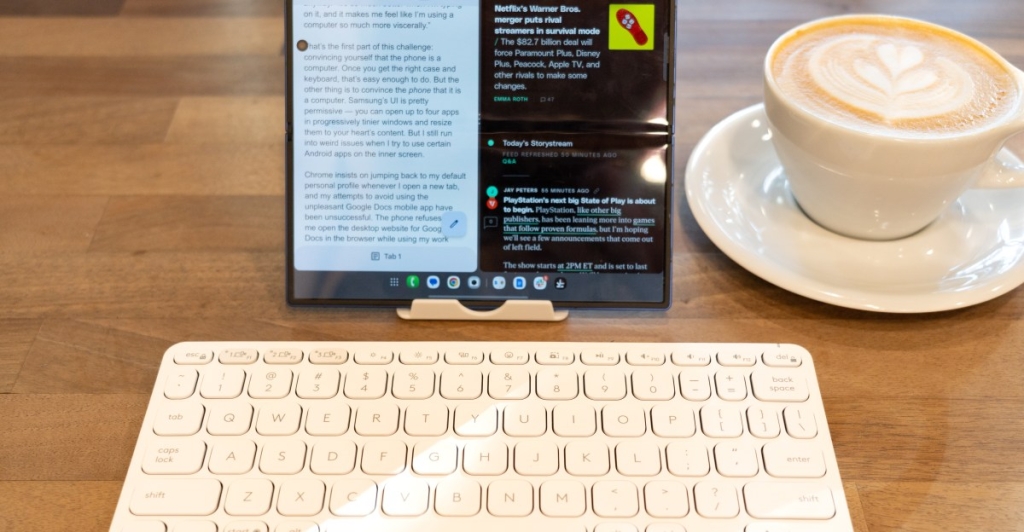
In a world obsessed with ever-lighter laptops and more portable computing solutions, one tech writer has discovered a surprisingly effective alternative that’s turning heads in coffee shops and coworking spaces alike. Welcome to the era of the “Purse Computer” – where a Samsung Galaxy Z Fold 7 and a compact keyboard combine to create a mobile workstation that’s changing how we think about productivity on the go.
The Accidental Discovery
It all started with a simple mistake. Allison Johnson, a tech writer for The Verge, grabbed her bag for a quick trip to a local coffee shop, confident she had everything needed for a productive work session. The key component? A new folding keyboard that would transform her Galaxy Z Fold 7 into a mobile workstation. As she walked, she marveled at how light her bag felt compared to carrying her MacBook. “It’s almost like it’s not there,” she thought.
The universe had other plans. Upon arrival, she discovered the keyboard wasn’t in her bag after all. Undeterred, she tapped out a few emails with her thumbs, enjoyed her latte, and walked home in what she describes as “shame.” But this embarrassing moment sparked an idea that would revolutionize her mobile work setup.
The Birth of Purse Computer
After testing every major phone released in 2025, Johnson found herself with time to revisit some favorites. The Galaxy Z Fold 7 caught her attention not just for its impressive specs, but for its remarkably slim and light design. Once she realized she was essentially carrying a keyboard-less Chromebook, the concept of Purse Computer was born.
The premise is brilliantly simple: combine a lightweight travel keyboard with a foldable phone to create a portable computing solution that’s lighter and more convenient than any laptop. “It’s not perfect, but I’m going to have a very hard time going back,” Johnson admits.
The Quest for the Perfect Keyboard
The journey to Purse Computer nirvana involved extensive experimentation with different keyboard options. Johnson’s requirements were specific: the keyboard needed to be light and small enough to barely notice in her bag, yet large enough to feel like a real keyboard during use.
Her trials included:
- A Protoarc folding keyboard (too big)
- A cheap Samsers model from Amazon (too “squirrelly”)
- Finally settling on the Logitech Keys 2 Go
The Logitech Keys 2 Go proved to be the winner, offering a perfect balance of portability and functionality. At just a fraction of an inch thick and weighing next to nothing, Johnson “barely notices it in her bag.” The full-size keys provide a satisfying typing experience that makes her feel like she’s using a real computer.
The Four-Pocket Laptop Concept
Interestingly, Johnson isn’t alone in her Purse Computer journey. Michael Fisher, better known as Mr. Mobile on YouTube and a folding phone enthusiast, has been experimenting with similar concepts since the Fold 3 launched in 2021. He’s dubbed this setup the “four-pocket laptop” – a nod to the minimal space required for this mobile workstation.
Fisher’s current setup includes a kickstand case (which he had to source from Taipei) and a Nuphy keyboard. His advice to Johnson was crucial: get a kickstand case. “It adds another pocket to it, it’s another thing to forget. It’s another thing to fiddle with when you’re setting it up,” he explained about using separate stands.
The Software Challenge
Creating a functional Purse Computer isn’t just about hardware – it requires some clever software workarounds too. Samsung’s UI is relatively permissive, allowing up to four apps to run in progressively smaller windows. However, Johnson encountered several frustrating limitations:
Chrome insists on jumping to her default personal profile whenever she opens a new tab. Attempts to use Google Docs through the mobile app proved unpleasant, and the phone refuses to let her open the desktop website for Google Docs in her work profile, no matter how many workarounds she tries.
Slack presents another challenge, making no use of the extra screen space and instead presenting a stretched version of the phone app with excessive white space. The solution? Opening Slack in a Chrome tab rather than the app itself – a workaround that requires outsmarting the phone’s default behavior.
The Invisible Ingredient: Patience
Perhaps the most crucial component of successful Purse Computer usage isn’t hardware or software – it’s patience. “It takes a certain kind of person to want to find a way to open Slack in a Chrome tab on the inner screen of a folding phone,” Johnson observes. The glances she receives at coffee shops suggest this isn’t for everyone.
There are also practical limitations to consider. Battery life falls short of her MacBook, and when the phone dies, so does her connection to the world. Johnson finds Purse Computer ideal for shorter stints – maybe an hour or two – but wouldn’t attempt a full workday without charging opportunities.
Why It Works: The Psychology of Portability
The true genius of Purse Computer lies not in its technical capabilities, but in its psychological impact. Johnson explains that the friction of packing up her backpack is often enough to keep her from leaving the house on most workdays. But when it’s just a matter of carrying the phone she was going to bring anyway, plus a tiny keyboard that fits in the small bag already on her bike, suddenly the decision becomes much easier.
This speaks to a fundamental truth about mobile computing: sometimes the barrier isn’t capability, but convenience. Purse Computer removes enough friction to make spontaneous work sessions feasible and appealing.
The Future of Mobile Computing
As Johnson prepares to test the upcoming Galaxy Z Trifold, she’s excited about the possibilities for further experimentation. The concept of leaving the laptop at home is becoming increasingly viable, especially as folding phones continue to improve in both hardware and software capabilities.
Fisher agrees, noting that “you have to use it to understand its utility.” Once you experience the freedom of Purse Computer, “going back to another phone starts to feel almost primitive.”
The Viral Potential
The Purse Computer concept has struck a chord with tech enthusiasts and productivity nerds alike. It represents a perfect storm of several trending topics:
- The ongoing miniaturization of technology
- The rise of remote and hybrid work
- The growing popularity of folding phones
- The eternal quest for the perfect mobile workstation
- The creative repurposing of existing technology
It’s the kind of story that spreads because it’s both practical and aspirational – showing how clever thinking can solve everyday problems in unexpected ways.
The Bigger Picture
Purse Computer represents more than just a clever workaround – it’s a glimpse into the future of mobile computing. As phones become more powerful and screens more flexible, the line between phone and computer continues to blur. Solutions like Purse Computer demonstrate that sometimes the best technology isn’t the newest or most expensive, but rather the most thoughtfully combined.
The concept also highlights an important truth about technology adoption: sometimes the most revolutionary changes come not from breakthrough innovations, but from creative recombination of existing tools. Purse Computer takes established technologies – a folding phone, a Bluetooth keyboard, some clever software tricks – and combines them in a way that feels genuinely new and useful.
Conclusion
Whether Purse Computer becomes a mainstream phenomenon or remains a niche solution for tech enthusiasts, it represents an important evolution in how we think about mobile productivity. It challenges our assumptions about what constitutes a “real” computer and demonstrates that sometimes the best solutions are the ones that make our lives simpler rather than more complicated.
As folding phones continue to evolve and improve, concepts like Purse Computer will likely become increasingly viable for more users. The future of mobile computing might not be about choosing between phone and laptop, but rather finding clever ways to make them work together seamlessly.
For now, Purse Computer remains a testament to human ingenuity and our endless quest to work smarter, not harder – all while carrying less weight on our shoulders and in our bags.
Tags: #PurseComputer #GalaxyZFold7 #MobileWorkstation #FoldingPhones #TechInnovation #RemoteWork #ProductivityHacks #MobileComputing #Samsung #Logitech #Keyboard #TechReview #HandsOn #Gadgets #MobileTech
Viral Sentences:
- “The first rule of Purse Computer is to check your bag before you leave the house.”
- “It’s not perfect, but I’m going to have a very hard time going back.”
- “Going back to another phone starts to feel almost primitive.”
- “You have to use it to understand its utility.”
- “The friction of packing up my backpack is just enough to keep me from leaving the house.”
- “It’s so much better when I’m typing on it, and it makes me feel like I’m using a computer so much more viscerally.”
- “It takes a certain kind of person to want to find a way to open Slack in a Chrome tab on the inner screen of a folding phone.”
- “The universe had other plans.”
- “I walked back home in shame.”
- “The key ingredient that would turn the Galaxy Z Fold 7 into a mobile workstation.”
- “The four-pocket laptop that’s changing how we think about productivity on the go.”
,


Leave a Reply
Want to join the discussion?Feel free to contribute!