
Why NASA is going nuclear for America’s power play on the moon
The New Space Race: America’s Nuclear Gamble on the Moon
In a dramatic revival of Cold War-era competition, the United States is racing against China to establish the first nuclear-powered base on the lunar surface—a technological moonshot with implications that could reshape both space exploration and global power dynamics.
Almost six decades after President John F. Kennedy challenged America to land a man on the moon “before this decade is out,” NASA and the Department of Energy have set another audacious end-of-decade deadline: demonstrating a 40-kilowatt nuclear reactor on the moon by 2030.
The Clock is Ticking
According to aerospace consultant Roger Myers, the timeline isn’t arbitrary—it’s a direct response to China’s lunar ambitions. Beijing has repeatedly announced plans to land its taikonauts on the moon by 2030 and establish a sustained presence by 2035.
“The United States has a decision to make,” Myers explains. “Do we want every human on the planet to look up every night and see just a Chinese flag? Or do we want them to see a Chinese and an American flag?”
This isn’t merely about planting flags or national prestige. The economic stakes are enormous. As humanity looks toward establishing a permanent presence beyond Earth, the moon represents humanity’s first extraterrestrial resource base—potentially containing helium-3, a rare isotope that could revolutionize quantum computing, medical imaging, and even fusion power.
Why Nuclear Power?
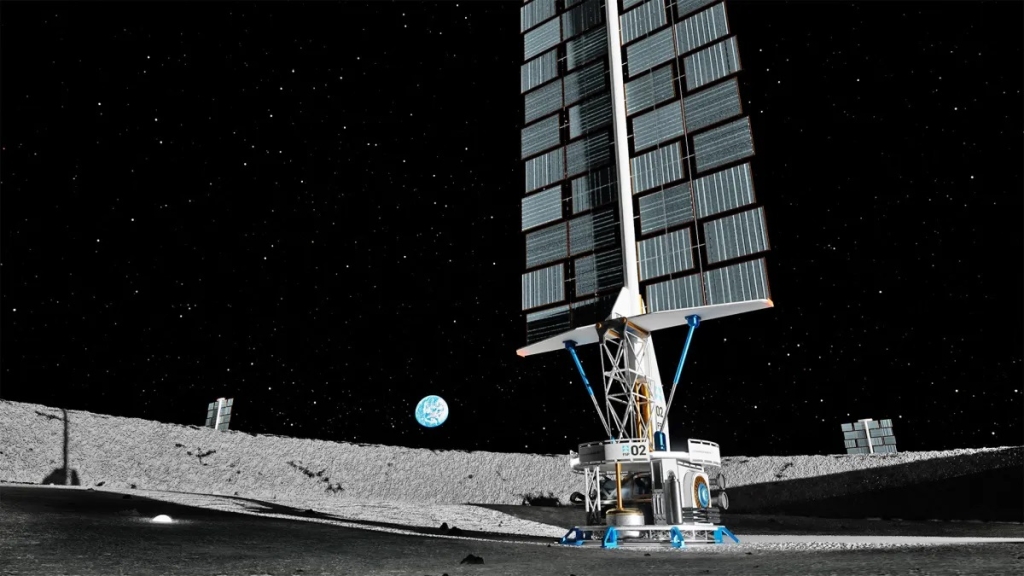
The moon presents unique challenges that make nuclear power not just advantageous but essential. A lunar night lasts two full weeks, during which solar panels become useless. While solar power towers could theoretically work in certain locations, scaling such systems to the 100+ kilowatts needed for resource exploitation and sustained human presence simply isn’t practical.
NASA Administrator Jared Isaacman has endorsed this assessment, calling for “grand, almost mini-Manhattan Project nuclear programs” that could support surface operations during lunar nights and enable manufacturing on other worlds.
The technology under development leverages small modular reactors (SMRs)—the same technology attracting billions in investment for Earth-based power generation. Companies like TerraPower (co-founded by Bill Gates) and NuScale Power are already pioneering these systems, which promise to be safer and more scalable than traditional nuclear plants.
The Players and the Prize
Congress has appropriated $250 million for fiscal year 2025 to advance this technology, funding a competition that could include aerospace giants like Lockheed Martin and L3Harris Technologies, nuclear industry leaders such as General Atomics and Westinghouse, and innovative startups like Radiant Nuclear (founded by SpaceX veterans).
The economic potential is staggering. Helium-3, which is far more abundant on the moon than on Earth, currently commands prices as high as $20 million per kilogram. Seattle-based Interlune is already developing extraction technology, betting that this isotope will become the “oil of the 21st century” for quantum computing and fusion applications.
Safety and the Final Frontier
Science fiction has long warned about the dangers of nuclear power in space—from the 1950s film “Destination Moon” to the TV series “Space 1999” and Apple TV’s “For All Mankind.” But Myers insists these scenarios misunderstand the technology being developed.
“The nice thing about these small reactors is, they don’t melt down,” he explains. “There’s not enough thermal energy in them to result in a meltdown.” As for nuclear waste, the plan is straightforward: bury the spent reactors once they’ve served their 10-15 year lifespan, using lunar bulldozers to dig deep holes.
The Broader Energy Ecosystem
While nuclear power may be the backbone of lunar operations, it’s part of a broader space energy revolution happening in Seattle and beyond:
- Zeno Power is developing nuclear batteries for rovers
- Blue Origin’s Blue Alchemist project aims to manufacture solar cells from lunar materials
- PowerLight Technologies is designing laser power transmission systems
- WiBotic is creating wireless charging for lunar rovers
The Geopolitical Stakes
The report co-authored by Myers and Bhavya Lal makes clear that this isn’t just about technology—it’s about maintaining American leadership in space. “Our government does not want our nation to be second,” Myers states. “We want to lead.”
The implications extend far beyond the moon. Establishing nuclear power capabilities on the lunar surface represents a critical stepping stone for deeper space exploration, including eventual missions to Mars and beyond. It’s about ensuring that as humanity expands into the solar system, American values and American leadership remain at the forefront.
As the 2030 deadline approaches, the race is on. Will America successfully establish the first nuclear-powered presence on the moon, or will China claim that historic first? The answer could determine not just who leads in space, but who shapes the economic and political future of the entire solar system.
nuclear moon base, lunar nuclear reactor, space race 2.0, China moon base 2030, NASA nuclear power, helium-3 mining, small modular reactors space, lunar resources, space economy, moon colonization, nuclear power moon, space nuclear technology, American leadership space, lunar night power, space geopolitics, moon base 2030, nuclear energy space exploration, extraterrestrial resources, space technology competition, moon power generation
,

Leave a Reply
Want to join the discussion?Feel free to contribute!