
Why the FCC’s router crackdown could leave you stuck with older Wi-Fi
The FCC’s Wi-Fi Router Ban: A Looming Crisis for Millions of Americans
In a move that has sent shockwaves through the tech industry, the Federal Communications Commission (FCC) has effectively banned the sale of most consumer Wi-Fi routers in the United States, leaving millions of Americans potentially stuck with outdated, insecure hardware.
The FCC’s March decision to block Wi-Fi consumer routers made or designed overseas has created an immediate crisis in the market. Virtually all routers sold in the U.S. are manufactured or designed abroad, either by foreign companies or contract manufacturers. This regulatory action doesn’t directly prohibit the sale of existing routers, but it prevents new models from receiving the necessary licensing and approval to enter the U.S. market.
The implications are far-reaching. The regulation effectively guarantees that consumers will be limited to router firmware updates through March 2027, after which the situation becomes uncertain. This creates a de facto cap on new router development, approval, and sales, potentially affecting the supply of even currently approved routers.
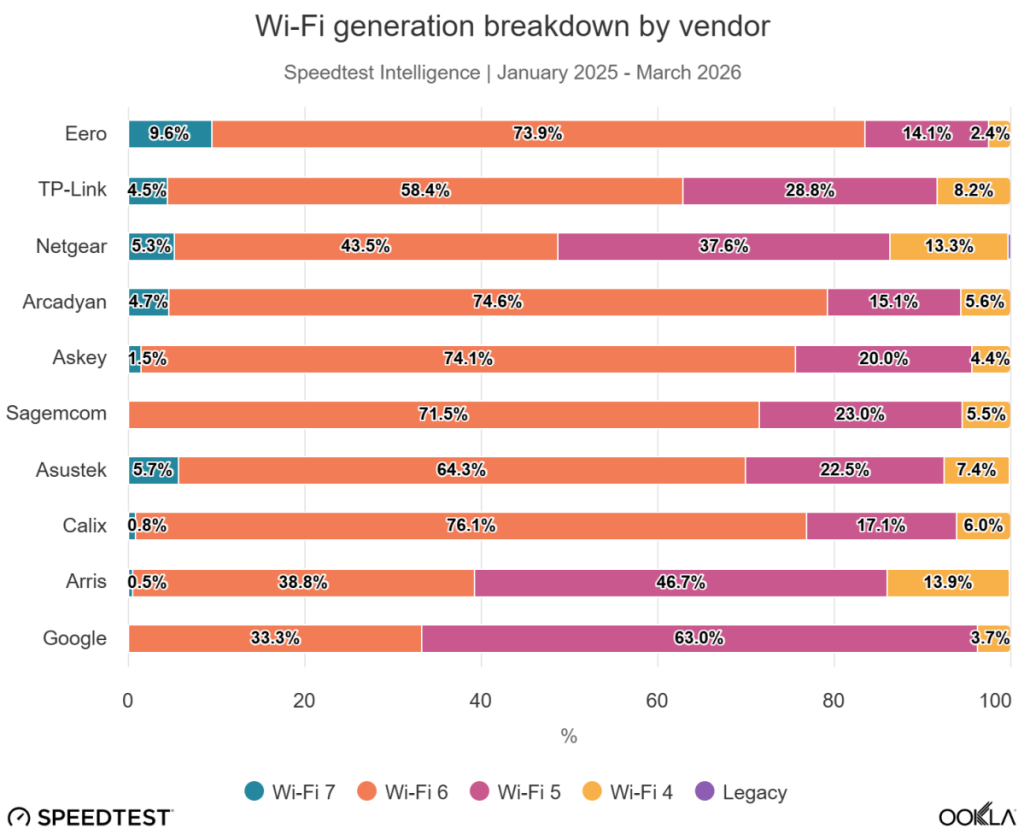
A recent study by Ookla, the company behind Speedtest, provides additional context to this developing situation. The study reveals that the top Speedtest users—used as a proxy for market share in the United States—not only use routers made outside the U.S. but that these devices are in dire need of upgrades.
The study also highlights another critical issue: many of the listed brands are not well-known retail names, suggesting they are “white label” hardware. Several brands on the list are actually used by major internet service providers (ISPs) like Comcast and Charter. Under the new rules, these ISPs would be prohibited from offering customers router upgrades or even firmware updates.
According to Ookla’s data, just over a third (35 percent) of all tested routers run either Wi-Fi 4 (802.11n) from 2009 or Wi-Fi 5 (802.11ac) from 2013. These older standards have been superseded by Wi-Fi 7 in 2023 and the upcoming Wi-Fi 8. The newer standards offer not only improved throughput and connectivity but also enhanced security features that help protect user data.
Amazon’s Eero tops the list of router brands used by Speedtest users. While Eero doesn’t disclose where its routers are manufactured, Ookla notes that building a consumer router entirely from U.S. components is currently impossible, as that part of the supply chain doesn’t exist domestically, according to analyst Avi Greengart of Techsponential.
Other major brands like Asustek and Arcadyan, headquartered in Taiwan, would likely be disqualified from future sales under the new rules. The majority of Eero routers use either Wi-Fi 7 or Wi-Fi 6, the most modern standards. In contrast, about 66 percent of Google’s router users are still on Wi-Fi 5 or Wi-Fi 4.
Ookla’s vendor list also includes several white-box brands that supply hardware to major ISPs. Arcadyan is the top vendor for Verizon customers, Arris supplies Comcast-branded routers, and Askey and Sagemcom provide hardware to Charter.
The issue isn’t about owning these routers—it’s about replacing them when they become obsolete or fail. Analysts have pointed out that the only routers likely to be entirely domestically designed and built are Starlink routers, though the company hasn’t confirmed this.
The industry and government now face a significant challenge: finding a middle ground that addresses security concerns without crippling consumer access to modern networking hardware. Without a solution, consumers may soon find themselves in a position where they must purchase all available modern routers before supplies run out—after which, there may be no replacements available.
As the situation develops, one thing is clear: the FCC’s decision has created a perfect storm that threatens to leave millions of Americans with outdated, potentially insecure home networks, while simultaneously disrupting the entire router manufacturing and supply chain. The coming months will be critical in determining whether a compromise can be reached or if consumers will indeed face a Wi-Fi router shortage that could last for years.
Tags: FCC, Wi-Fi router ban, cybersecurity, internet infrastructure, consumer technology, hardware shortage, regulatory policy, network security, wireless standards, Starlink, Eero, Amazon, Google, Comcast, Verizon, Charter, Ookla, Speedtest, 802.11n, 802.11ac, Wi-Fi 6, Wi-Fi 7, Wi-Fi 8, supply chain, tech industry crisis, government regulation, firmware updates, white label hardware, ISP equipment, domestic manufacturing, tech policy, internet access, home networking, router security, wireless technology, FCC ruling, consumer rights, technology regulation, network equipment, internet service providers, hardware manufacturing, tech supply chain, cybersecurity policy, wireless standards evolution, router firmware, internet infrastructure security, technology compliance, FCC oversight, consumer electronics, network hardware, wireless communication, internet connectivity, technology manufacturing, regulatory compliance, network security standards, wireless router technology, internet service delivery, hardware lifecycle, technology policy impact, consumer technology access, network equipment regulation, wireless standard adoption, internet infrastructure modernization, technology industry disruption, consumer protection, network hardware supply, wireless technology policy, internet service quality, technology manufacturing challenges, network security compliance, wireless device regulation, internet access technology, hardware security features, technology industry regulation, network equipment availability, wireless communication standards, internet service provision, technology manufacturing localization, network hardware security, wireless device security, internet infrastructure development, technology regulatory challenges, network equipment modernization, wireless technology evolution, internet service enhancement, hardware security compliance, technology industry adaptation, network security requirements, wireless device manufacturing, internet access improvement, hardware technology advancement, technology regulatory solutions, network equipment innovation, wireless communication development, internet service optimization, hardware security enhancement, technology industry response, network security advancement, wireless device evolution, internet access technology, hardware technology progress, technology regulatory framework, network equipment advancement, wireless communication progress, internet service advancement, hardware security progress, technology industry progress, network security progress, wireless device progress, internet access progress, hardware technology progress, technology regulatory progress, network equipment progress, wireless communication progress, internet service progress.
,


Leave a Reply
Want to join the discussion?Feel free to contribute!