
Yeah, I’d take Panther Lake in a desktop PC
Panther Lake’s Integrated Graphics: A Game-Changer for Small Form Factor PCs
I’m genuinely excited about Intel’s Panther Lake architecture, specifically its integrated graphics capabilities and what they could mean for the future of PC building. The performance Intel has squeezed into these mobile chips is nothing short of remarkable.
This isn’t entirely new territory, of course. AMD beat Intel to the punch last year with its Strix Halo APU, which made serious waves across the tech community. Our team at PCWorld found ourselves repeatedly discussing AMD’s breakthrough, with the Full Nerd crew and other staffers marveling at what AMD had accomplished. But now that Intel has entered the fray with Panther Lake, a personal dream of mine feels increasingly within reach.
My colleague Mark Hachman’s extensive testing revealed that Intel’s new mobile architecture can nearly rival discrete GPUs. That’s a bold claim, and one that deserves serious consideration. During our recent show, I was asked about the potential implications for budget discrete graphics cards—and yes, I’ll admit it’s a bit unnerving. I don’t want integrated graphics, no matter how impressive, to completely replace discrete cards. The ability to swap out a video card, especially when one fails or becomes outdated, shouldn’t be a luxury reserved only for those who can afford higher-end components.
Instead, I want to see powerful integrated graphics become an additional option for PC gamers and DIY builders. The possibilities for small form-factor PCs are particularly exciting. Imagine what this could do for compact builds that have traditionally been limited by thermal constraints and power delivery.
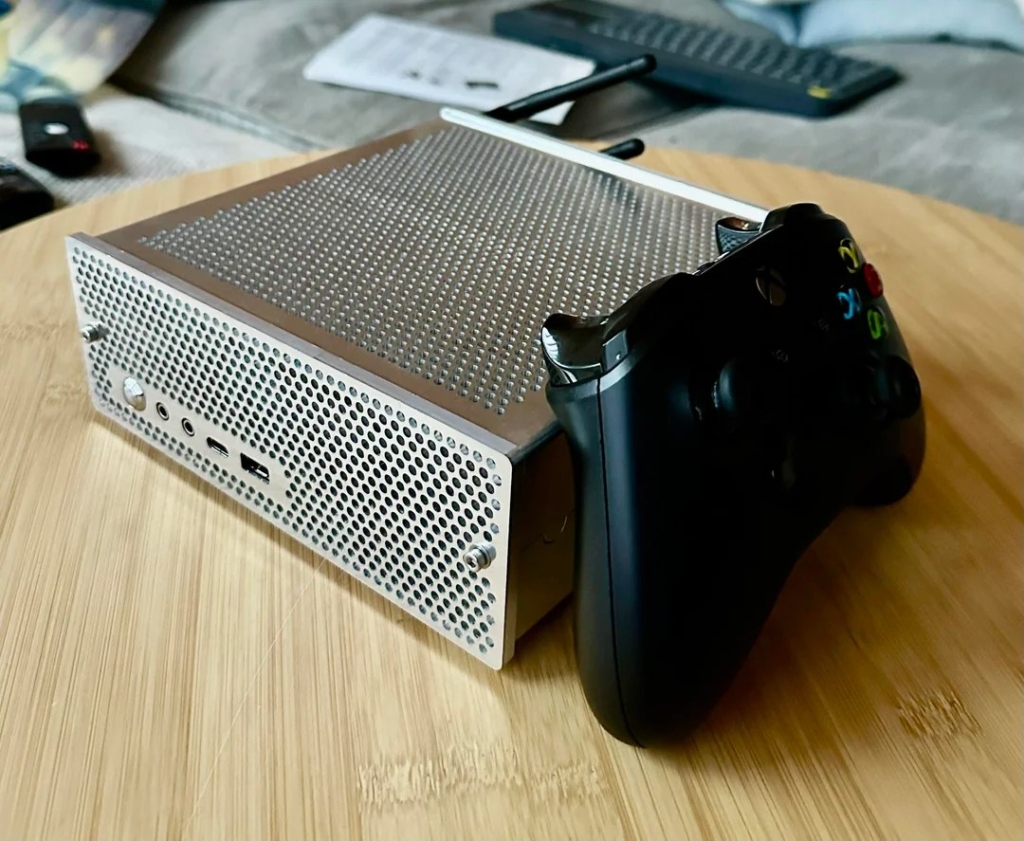
Take this incredible 1.8L RTX 5060 build from the r/sffpc community, crafted by u/Bjoes92. It’s a stunning piece of engineering that showcases just how far small form factor building has come. Right now, there’s a hard line between mini-PCs and small form-factor builds, but what if that distinction began to blur?
In an ideal world, I’d love to see chips like Panther Lake expand beyond laptops into not just mini-PCs but SFF builds that exist in that sweet spot between fully DIY and bare-bones kits. Perhaps mini-STX (or an even smaller variant) could emerge as a standard motherboard option where a Ryzen AI Max+ or Panther Lake-style chip is soldered directly onto the board. Or, if AMD’s surprising hints at CES are any indication, we might see socketed versions of mobile parts designed specifically for desktop use.
The fact that AMD floated the idea of mobile chips in socketed boards suggests I’m not alone in thinking about this. Heck, it sounds like I’m actually late to the party.
I’d thoroughly enjoy doing speed-run SFF builds with a hybrid approach—part DIY, part bare-bones kit. Lots of performance, minimal time investment to get up and running, and the freedom to choose your own case and cooling? Sign me up. It would essentially be a more DIY-friendly version of Intel’s Compute Element concept, but with more staying power. (The Compute Element, despite its innovative design, didn’t survive long after its 2020 debut.)
Don’t get me wrong—I’m still concerned about the future of budget discrete GPUs. But realistically, consumer technology doesn’t appear poised for the same dramatic leaps we saw during the past decade. So during this period of relative stagnation, I’d like to at least see innovation around efficiency—advancements that reduce the necessary size and energy consumption of everyday PC components.
With so much emphasis in the last decade on pushing performance boundaries (which was absolutely necessary given the years of stagnation before AMD’s Ryzen launch), optimization could use some growth. When consumer hardware once again charges ahead, we home users would benefit from a landscape that pays equal attention to optimized hardware. (The cost of living isn’t getting any cheaper, especially when it comes to real estate and energy costs.)
There will always be room on my desk for a full-powered desktop PC, but I love options. I love choice. I really love small PCs. The idea of broader flexibility and power in a mini footprint is genuinely exciting to me.
This Week on The Full Nerd
In this episode of The Full Nerd, Adam Patrick Murray, Alaina Yee, Mark Hachman, and Will Smith dig into Mark’s testing of Intel Panther Lake (and what that means for other 18A products), Arrow Lake refresh rumors, and gaming performance on Windows 10 vs. Windows 11. Will and Mark also share tales of random wildlife. (Will’s take on weasels: “They’re like [mice], but long.”)
We also once again go long with viewer Q&A (a whole 45 minutes!), which means y’all have many things to ask us. We love it. (For real.)
Missed our live show? Subscribe now to The Full Nerd Network YouTube channel, and activate notifications. We also answer viewer questions in real-time!
Don’t miss out on our NEW shows too—you can catch episodes of Dual Boot Diaries and The Full Nerd: Extra Edition on our channel, too. PLUS! Adam just teased a new joint endeavor with Retro Gaming Corps…
And if you need more hardware talk during the rest of the week, come join our Discord community—it’s full of cool, laid-back nerds.
This Week’s Varied Nerd News
I found myself poking all over the internet this week for interesting tidbits—and it was surprising what turned up. Obviously, the big news was AMD’s launch of the 9850X3D, which Adam tested for us. But I had never given much deep thought to China’s own memory production before, which Gamers Nexus helped fix for me. (Thanks, Steve!)
Adam tested the 9850X3D: As I note in my written summary of his findings, it’s…fine. Yes, it’s the best gaming CPU. But the overall landscape for DIY building complicates its appeal.
I want to try this now: One determined British dude repurposed the standard telephone wiring in his home for gigabit ethernet. This is absolutely me now researching whether U.S. telephone lines are similarly capable.
Sigh: The United State’s cyber defense chief uploaded sensitive information into the public version of ChatGPT.
The rise of Chinese memory: This deep-dive from Gamers Nexus into China’s investment into memory manufacturing is both educational and fascinating.
I’m nervous: Supposedly, the first look at Google’s new AluminumOS recently leaked—and while I’m hopeful about its eventual launch, I’m also still worried. (What will happen to ChromeOS Flex?)
Oops: A five-ton Japanese satellite fell off the rocket it was attached to during flight. Somehow, this feels like a light moment, thanks to the image released by Japan’s space agency illustrating what happened. (Also, my tax dollars didn’t pay for it, so.)
The sound will remain forever in my head: Microsoft just purposely broke modem support in Windows 11. The reason makes sense, but the outcome is still a bit sad.
Better late than never: Having a succession plan is a wise idea for any group—so this is a smart move on the Linux community’s part.
Found the problem: Small form-factor haters criticize builds for not enough airflow. This post in the r/SFFPC subreddit clearly illustrates the real issue. The real cute (yet still very problematic) issue.
Catch you all next week—it should be a bit warmer at last. Also, you know how when you live in an area, certain things don’t faze you? For example, earthquakes are normal to me, but PCWorld’s east coast staffers seem mildly alarmed whenever we west coasters mention them.
Well, I had the reverse experience upon learning that you can have a heart attack while shoveling snow. Our east coast crew? They only said, “Oh yeah, that totally happens on occasion out here.”
I’m glad I live in a temperate climate.
Alaina
This newsletter is dedicated to the memory of Gordon Mah Ung, founder and host of The Full Nerd, and executive editor of hardware at PCWorld.
Tags
Intel #PantherLake #IntegratedGraphics #SmallFormFactor #SFFPC #PCBuilding #Gaming #Hardware #TechNews #AMD #Ryzen #StrixHalo #MiniPC #DIY #ChromeOS #AluminumOS #Linux #Memory #ChinaTech #Windows11 #Windows10 #RTX5060 #Reddit #r/sffpc #Discord #TheFullNerd #PCWorld
Viral Phrases
- “Panther Lake’s integrated graphics nearly rival discrete GPUs”
- “The future of small form factor PCs is looking bright”
- “Intel enters the integrated graphics arena”
- “AMD hinted at socketed mobile chips for desktops”
- “The line between mini-PCs and SFF builds is blurring”
- “Speed-run SFF builds with hybrid DIY approach”
- “Optimization is the next frontier in PC hardware”
- “Choice and flexibility in mini footprints”
- “The sound of dial-up modems will live forever in our heads”
- “Heart attacks while shoveling snow: a real concern”
,


Leave a Reply
Want to join the discussion?Feel free to contribute!