
Roundtables: Why AI Companies Are Betting on Next-Gen Nuclear
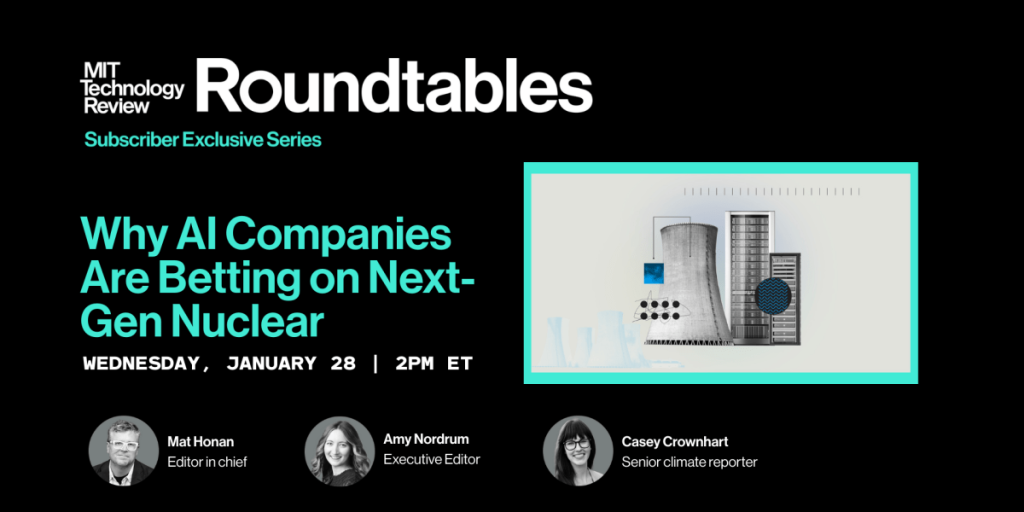
AI’s Unprecedented Power Demands Spark Interest in Next-Gen Nuclear for Data Centers
The artificial intelligence revolution is fueling an unprecedented wave of investment in massive data centers, creating an urgent need for energy sources capable of supporting AI’s voracious computational appetite. As hyperscale facilities multiply across the globe to train increasingly complex models, the electricity demands are reaching staggering proportions—some estimates suggest a single large AI training cluster could consume as much power as a small city.
This energy challenge has sparked renewed interest in next-generation nuclear power plants as a potential solution. Unlike traditional nuclear facilities, these advanced reactors promise to be both cheaper to construct and safer to operate, potentially addressing two of the most significant barriers that have historically limited nuclear expansion.
The economics are compelling. Traditional nuclear plants require massive upfront capital investments—often exceeding $10 billion—and can take a decade or more to build. Next-generation designs, including small modular reactors (SMRs) and microreactors, aim to slash these costs through factory-based construction, standardized designs, and modular deployment. Some companies project construction costs could fall by 50% or more compared to conventional plants.
Safety improvements are equally significant. Advanced reactor designs incorporate passive safety systems that can cool the reactor without human intervention or external power sources. Some utilize molten salt or liquid metal coolants that operate at lower pressures and are less prone to catastrophic failure. Others employ fuel designs that are inherently more resistant to meltdown scenarios.
Major technology companies are already exploring these possibilities. Microsoft has signed agreements to purchase power from advanced nuclear projects, while Google has invested in nuclear fusion startups. Amazon recently acquired a data center campus adjacent to a nuclear power plant, signaling serious interest in nuclear-powered AI infrastructure.
The timing aligns with regulatory momentum. The U.S. Nuclear Regulatory Commission has approved several advanced reactor designs, and the Department of Energy has committed billions in funding for demonstration projects. Internationally, countries from Canada to Poland are advancing policies to support next-gen nuclear deployment.
However, significant challenges remain. Supply chain constraints for specialized components, skilled workforce shortages, and public perception issues continue to pose obstacles. Additionally, the technology is still maturing—most advanced reactors won’t reach commercial operation until the late 2020s or early 2030s.
The intersection of AI’s exponential growth and nuclear innovation represents a critical juncture for both industries. As AI models become more sophisticated and data centers expand, the energy equation becomes increasingly complex. Next-generation nuclear could provide the reliable, carbon-free baseload power needed to sustain AI’s trajectory while addressing climate concerns.
This convergence was recently highlighted in MIT Technology Review’s “10 Breakthrough Technologies of 2026” list, which featured both hyperscale AI data centers and next-generation nuclear power as transformative technologies shaping our future. The recognition underscores how these seemingly disparate fields are becoming inextricably linked in the pursuit of artificial intelligence at unprecedented scales.
next-generation nuclear reactors, AI data centers, hyperscale computing, small modular reactors, advanced nuclear technology, energy infrastructure, AI computational power, nuclear safety improvements, data center electricity demands, carbon-free energy, Microsoft nuclear agreements, Google nuclear investments, Amazon nuclear acquisition, NRC advanced reactor approval, DOE nuclear funding, factory-built reactors, passive safety systems, molten salt reactors, liquid metal coolants, nuclear supply chain, skilled nuclear workforce, public perception nuclear, baseload power AI, climate-conscious computing, MIT Technology Review breakthrough technologies, AI energy consumption, nuclear construction costs, modular nuclear deployment, AI training clusters, nuclear fusion startups, data center power solutions, advanced reactor designs, nuclear regulatory approval, international nuclear policy, AI infrastructure growth, reliable AI power, sustainable AI development, nuclear demonstration projects, AI computational appetite, next-gen reactor economics, nuclear safety systems, AI carbon footprint, data center energy crisis, nuclear technology maturation, AI power partnerships, hyperscale facility construction, nuclear workforce development, AI energy partnerships, advanced nuclear deployment, data center sustainability, nuclear public acceptance, AI energy innovation
,

Leave a Reply
Want to join the discussion?Feel free to contribute!