
Can AI revive democracy? Former Amazon product manager builds tool to spark civic engagement
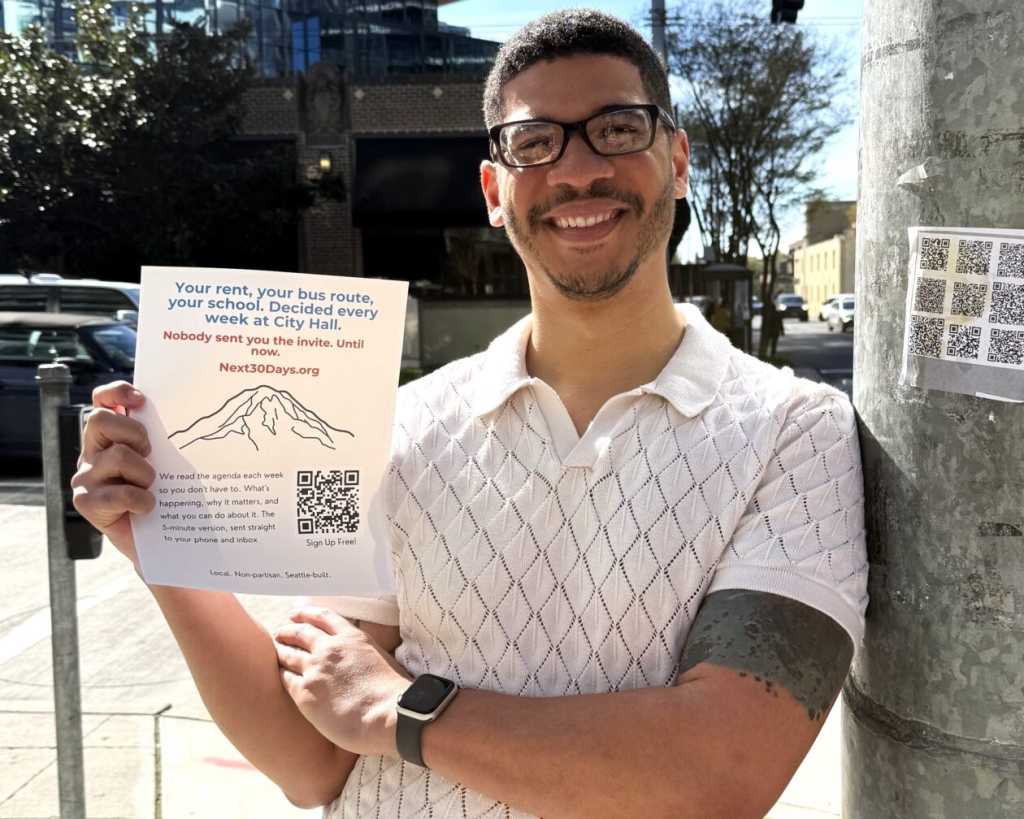
Julien Clayton is no stranger to solving complex problems. From engineering nuclear propulsion systems for Navy submarines to building data tools at Amazon, he’s spent his career translating technical complexity into clarity. But after being laid off during Amazon’s sweeping workforce reductions, Clayton found himself staring at his phone late one night, scrolling through the endless churn of national headlines. Like many Americans, he felt overwhelmed, powerless, and disconnected from the issues that seemed to dominate the news.
Then came a realization that would change the trajectory of his work: the real levers of change aren’t always in Washington, D.C. — they’re often in city council chambers, school board meetings, and local planning sessions.
The problem? Most people have no idea when these meetings happen, what’s on the agenda, or how to get involved. City websites are notoriously difficult to navigate, and meeting agendas can run dozens of pages long, filled with jargon and procedural language that deters even the most civic-minded residents.
That’s where Next30Days comes in — a web app and email digest designed to bridge the gap between information and action. Powered by AI, the platform scrapes upcoming meeting data from Legistar (the legislative management system used by thousands of cities nationwide), translates dense agendas into plain English, and gives residents a clear, actionable path to participate — both in-person and virtually.
The name itself is a challenge: “What is one action you can take within the next 30 days to become more engaged in your local government and active in your community?”
Here’s how it works: Users select their city (currently Seattle and Bellevue) and choose topics they care about — from housing and transportation to public safety and schools. Twice a week, they receive a curated email digest summarizing upcoming meetings, what’s at stake, and how they can get involved. Each event includes a plain-language summary, a link to watch the meeting online, and a button to commit to attending — either in-person or virtually.
Clayton is also building a social proof feature, which will show how many neighbors have signed up for a given meeting. “A lot of people are afraid to show up to city council by themselves,” he explained. “If you can get a group of 10 people showing up to speak on something, you really can make an impact.”
Technically, Next30Days is a marvel of modern no-code and AI tooling. Clayton used Claude Code and other AI tools to write much of the codebase. The front end is hosted on Vercel, while user data is stored in Google’s Firestore — a choice driven by security concerns, given that the data often reflects users’ political interests. The AI curation pipeline runs on the n8n automation platform, with multiple layers of accuracy checks: one step summarizes the agenda, a second verifies details like dollar figures against the original document, and a third does an additional pass. If confidence falls below a set threshold, the item gets kicked to Clayton for manual review.
The out-of-pocket costs have been minimal. Clayton has been bootstrapping the project so far, printing flyers and posting them around downtown Seattle, South Lake Union, Capitol Hill, and Belltown to attract initial users. The grassroots approach paid off, building a small but dedicated group of early adopters.
Clayton’s path to Next30Days is as unconventional as the app itself. He grew up in Houston, studied nuclear engineering at Texas A&M, and spent six years at General Dynamics Electric Boat in Connecticut, working on propulsion systems for Navy submarines. After earning his MBA from Harvard Business School, he interned at Amazon, returned full-time as a senior technical product manager, and was laid off during the company’s broader cutbacks.
But rather than seeing the layoff as a setback, Clayton viewed it as an opportunity. He launched Next30Days with a small friends-and-family test in February, then hit the streets with flyers, sparking curiosity and engagement in the process.
Next30Days isn’t the only player in the space. A growing number of services are using AI to make local government more accessible, including Aware AI, Civic Sunlight, and Go Vocal (formerly CitizenLab). But Clayton believes his app stands out by focusing not just on information, but on action. “There are tools that summarize meetings,” he said. “Nothing really tries to bridge that gap between giving people the information and actually getting them to show up.”
Looking ahead, Clayton is eyeing expansion to Tacoma, Redmond, and beyond. The Legistar API makes scaling straightforward, since so many cities use the same system. For cities that don’t have the API, he could scrape publicly available data from city websites. Long-term, he’s considering a low-cost subscription model — possibly $1 to $2 a month — or partnerships with municipalities. But the core product, he insists, should always be free. “I don’t think money should ever be a barrier to people getting involved in their government,” he said.
In a time when civic engagement often feels like shouting into the void, Next30Days offers a practical, tech-driven solution to a real problem. By lowering the barriers to participation, Clayton hopes to empower residents to take ownership of their communities — one meeting at a time.
—
# Tags & Viral Phrases:
– AI-powered civic engagement
– Next30Days app
– Julien Clayton
– Boost local government participation
– Plain English meeting summaries
– Tech for democracy
– From submarines to city councils
– Amazon layoff to startup founder
– Legistar API automation
– Social proof for civic action
– Free tools for community involvement
– TechCrunch-worthy civic tech
– Harvard MBA meets grassroots activism
– n8n automation pipeline
– Vercel-hosted civic platform
– Google Firestore for political data
– Claude Code for civic coding
– Turning frustration into action
– The future of local democracy
– Civic engagement made simple,


Leave a Reply
Want to join the discussion?Feel free to contribute!