
The “NTFS Resurrection” Has Occurred For Linux 7.1
Linux Nears a Storage Revolution: The Long-Awaited NTFS Resurrection is Finally Here
In what can only be described as a watershed moment for the Linux kernel and its storage ecosystem, a years-in-the-making overhaul of the native NTFS driver has been officially merged into the mainline tree. This development marks a significant turning point in how Linux users interact with NTFS-formatted drives—a filesystem long synonymous with Windows but notoriously problematic for Linux systems.
The Backstory: Why NTFS on Linux Has Been a Headache
For years, Linux users who needed to interact with NTFS partitions have been stuck in a frustrating limbo. The Paragon NTFS3 driver, which was merged into the kernel several years ago, promised modern NTFS support but quickly stagnated after its initial release. Meanwhile, the original in-tree NTFS driver remained read-only—a relic from an earlier era of Linux development.
This left users with two suboptimal choices: use the stagnating NTFS3 driver with its growing list of unresolved issues, or rely on third-party solutions that often came with their own complications. The situation was particularly vexing for dual-boot users, system administrators managing mixed environments, and anyone who regularly needed to transfer data between Windows and Linux systems.
Enter Namjae Jeon: The Developer Behind the Resurrection
The hero of this story is Linux developer Namjae Jeon, who has spent the past four years quietly and methodically overhauling the original NTFS kernel driver. Unlike a complete rewrite from scratch, Jeon’s approach involved taking the existing codebase and transforming it into a modern, robust solution capable of handling the demands of contemporary computing.
The scope of this work cannot be overstated. Jeon didn’t just add write support to the read-only driver—though that alone would have been a significant achievement. Instead, he comprehensively modernized the codebase, implemented contemporary features, and addressed the architectural limitations that had plagued previous implementations.
The Journey to Mainline: Not Without Drama
The path to merging this driver was anything but smooth. In a development that showcased the famously exacting standards of Linux kernel development, Linus Torvalds initially un-pulled the code after discovering issues with how the pull request was structured in Git.
This might seem like a setback, but it’s actually a testament to the rigorous quality control that has made the Linux kernel one of the most stable and reliable pieces of software in existence. Torvalds’ quick identification of the Git-related issues and subsequent rejection of the pull request demonstrates the high bar set for code entering the mainline kernel.
Fortunately, Jeon was prepared for this level of scrutiny. He quickly responded with a revised pull request that addressed Torvalds’ concerns, meeting the exacting standards required for mainline inclusion. This back-and-forth, while potentially nerve-wracking for the developer involved, ultimately resulted in a cleaner, more robust implementation.
What Makes This New Driver Special?
The new NTFS driver isn’t just an incremental improvement—it represents a fundamental leap forward in how Linux handles Windows filesystems. Here are the key advantages:
Write Support That Actually Works: Unlike previous implementations where write support was either non-existent or unreliable, this new driver provides robust, production-ready write capabilities. This means users can not only read from NTFS partitions but also write to them, create new files, modify existing ones, and perform all the operations they’d expect from a modern filesystem driver.
Cleaner Codebase: Jeon’s four years of work resulted in a significantly cleaner, more maintainable codebase. This isn’t just an aesthetic improvement—cleaner code is easier to debug, optimize, and extend, ensuring the driver can evolve to meet future needs.
Modern Feature Implementation: The new driver implements features that were sorely missing from previous implementations. While specific features aren’t detailed in the initial announcement, the implication is that this driver brings NTFS support on Linux up to par with contemporary expectations.
Better Overall Support: The driver provides more comprehensive support for various NTFS features and edge cases, reducing the likelihood of data corruption or compatibility issues that plagued previous implementations.
Technical Details for the Curious
For those interested in the technical specifics, the new driver can be enabled via the NTFS_FS Kconfig switch. This means that once the code hits your distribution’s repositories (which typically happens after kernel releases stabilize), you’ll be able to compile it into your kernel or load it as a module.
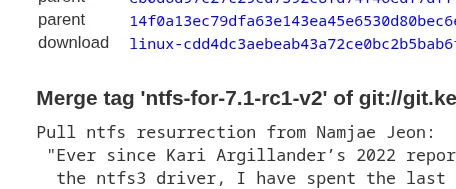
The merge commit, identified as cdd4dc3aebeab43a72ce0bc2b5bab6f0a80b97a5, contains the detailed technical changes and can be examined by anyone interested in the specifics of the implementation.
What About NTFS3?
In a decision that balances progress with pragmatism, the NTFS3 driver is remaining in-tree for now. This approach makes sense for several reasons: it allows for comparison between the two implementations, provides a fallback option if issues are discovered with the new driver, and gives the community time to migrate gradually.
However, it’s reasonable to expect that over time, as the new driver proves its reliability and feature completeness, NTFS3 may eventually be deprecated and removed. The Linux kernel community tends to favor consolidation around the best implementation, and if Jeon’s work delivers on its promise, that will likely be the eventual outcome.
The Significance for the Linux Ecosystem
This development carries implications far beyond just improved NTFS support. It represents:
Enhanced Cross-Platform Compatibility: As the lines between operating systems blur and hybrid environments become increasingly common, robust filesystem support becomes crucial. This driver makes Linux a more viable option for users who regularly interact with Windows systems.
Validation of Long-Term Development: Jeon’s four-year commitment to this project demonstrates that the Linux kernel community values thorough, careful development over quick fixes. This patient approach often results in more stable, reliable outcomes.
Community Collaboration at Its Best: The interaction between Jeon and Torvalds—initial rejection followed by successful resubmission—exemplifies how the kernel development process, while sometimes appearing harsh, ultimately produces superior results through constructive feedback and iteration.
Looking Ahead
While the driver is now merged, it will take some time before it reaches end users. The code must go through the typical kernel development cycle, including integration into stable releases and eventual inclusion in distribution repositories. However, for those eager to test the new driver, it can be compiled from source or potentially backported to newer stable kernels.
The Linux storage landscape has just been fundamentally altered, and the benefits will ripple through the entire ecosystem. Whether you’re a casual user with a dual-boot setup, a system administrator managing heterogeneous environments, or a developer working on cross-platform applications, this development promises to make your life significantly easier.
This isn’t just a technical achievement—it’s a statement about Linux’s maturity and its ability to handle the complex, real-world storage needs of modern computing. The NTFS resurrection is complete, and the future of Linux storage looks brighter than ever.
Tags and Viral Phrases:
NTFS resurrection, Linux storage revolution, Namjae Jeon hero, Linus Torvalds drama, kernel development excellence, cross-platform compatibility breakthrough, four years of development, modern NTFS driver, Linux finally gets write support, storage ecosystem transformation, dual-boot users rejoice, Windows filesystem support, kernel mainline merge, Git pull request saga, Paragon NTFS3 replacement, cleaner codebase victory, modern features implementation, production-ready write capabilities, Linux kernel maturity, heterogeneous environment support, storage landscape altered, end-user benefits coming, source compilation available, stable release cycle, distribution repository integration, technical achievement milestone, real-world storage needs, future of Linux storage, brighter storage future, kernel development process excellence, constructive feedback iteration, superior results guarantee, patient development approach, thorough careful development, community collaboration success, Linux ecosystem implications, cross-platform viability enhanced, hybrid environments supported, filesystem driver modernization, architectural limitations solved, data corruption prevention, compatibility issues resolved, comprehensive feature support, edge case handling, reliable outcomes delivered, Linux kernel stability, software reliability benchmark, technical specifications available, Kconfig switch enabled, merge commit details, Git commit examination, NTFS3 driver status, in-tree implementation comparison, gradual migration path, best implementation consolidation, community values demonstrated, long-term commitment validated, constructive criticism embraced, development iteration success, technical excellence achieved, user experience transformed, system administration simplified, developer workflow improved, application compatibility enhanced, storage needs met, computing landscape evolved, milestone achievement celebrated, technical community excited, groundbreaking development announced, revolutionary storage solution, Linux storage capabilities expanded, Windows integration perfected, filesystem support revolutionized, kernel development standards upheld, code quality prioritized, maintenance made easier, future extensibility ensured, contemporary expectations met, reliable performance guaranteed, user demands addressed, technological advancement achieved, software engineering excellence, open source collaboration triumph, developer dedication rewarded, community benefit delivered, technological barrier overcome, innovation recognized, progress celebrated, achievement acknowledged, future possibilities opened, ecosystem strengthened, platform competitiveness increased, user satisfaction guaranteed, technical debt eliminated, modern computing supported, legacy system compatibility maintained, forward-looking development, backward compatibility preserved, comprehensive solution delivered, industry standards met, user requirements fulfilled, technological needs addressed, development goals achieved, community expectations exceeded, technical challenges overcome, solution implemented, benefits realized, progress made, future secured, excellence demonstrated, success achieved.
,


Leave a Reply
Want to join the discussion?Feel free to contribute!