
These fifth graders vibe coded a real-world Braille tool — and wowed their Microsoft teacher
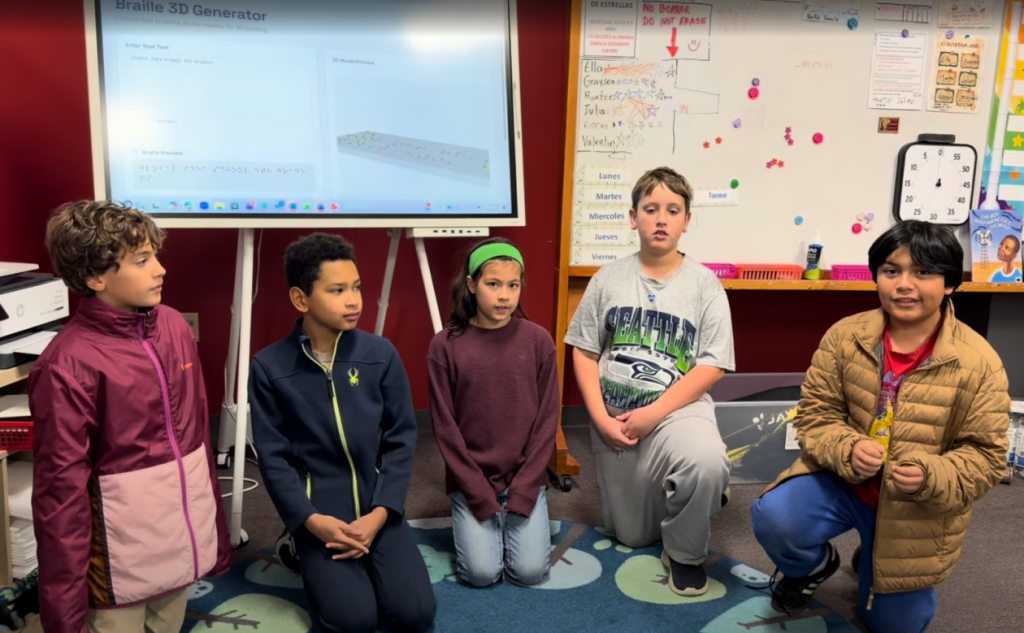
Fifth Graders Build AI-Powered Braille 3D Generator, Proving the Future of Coding Is Voice-Activated
In a stunning display of how artificial intelligence is democratizing technology, a group of fifth graders in Redmond, Washington, have built an AI-powered tool that converts text into 3D-printable Braille models—without writing a single line of traditional code.
The students, aged 10-11, attend the Global Idea School, an independent elementary school where technology meets purpose. Under the guidance of Juan Lavista Ferres, Microsoft’s VP and director of the AI for Good Lab, these young innovators created the Braille 3D Generator using GitHub Spark, a platform that allows users to build web applications through natural language prompts alone.
From Classroom Concept to Real-World Solution
What started as a classroom project to help blind or low-vision students navigate their school has evolved into a potentially transformative accessibility tool. The students interviewed Anne Taylor, Microsoft’s principal program manager for Accessibility and an expert in Braille embossers, to ensure their solution would be genuinely useful for the visually impaired community.
“We live in an amazing time,” Lavista Ferres remarked. “The fact that a 10-year-old can do it in a class without any training? That thing is an actual working solution.”
The tool works by taking any text input and instantly generating a 3D model of the corresponding Braille characters, ready for 3D printing. This could dramatically reduce the cost of creating Braille signage for schools, businesses, and public spaces—making accessibility more affordable and widespread.
Vibe Coding: The New Language of Innovation
The students’ achievement showcases the power of “vibe coding,” a modern approach to software development where programmers describe what they want in plain English and let AI generate the underlying code. Using GitHub Spark, the fifth graders simply told the AI what they wanted to create, and the platform handled the complex coding automatically.
“Instead of having to type the code, we could just say English to the AI and it would make this whole app,” explained Grayson, one of the student developers.
What makes this achievement particularly remarkable is that GitHub Spark typically generates React code for web applications. Lavista Ferres didn’t even realize the platform could produce 3D models until his students experimented with it. “When I saw the output, I was like, ‘wow,'” he said. “I’ve been vibe coding for some time now. I wasn’t aware that we could do this.”
Youngest Entrants in National AI Competition
The Global Idea School team became the youngest ever to enter the “AI for a Better World” competition, a national initiative in collaboration with MIT that invites students in grades 6-12 to explore how artificial intelligence can improve their communities. Their entry demonstrates that age is no barrier to meaningful innovation when powerful AI tools are accessible.
The students also visited Microsoft’s Inclusive Tech Lab, where they saw firsthand how people with disabilities interact with specialized computer keyboards, game controllers, and other adaptive technologies. This experience helped them understand the real-world impact of their project.
A Glimpse Into Tomorrow’s Tech Workforce
For Lavista Ferres, this project represents more than just an impressive school assignment—it’s a preview of how future technology professionals will work. Having spent 17 years at Microsoft and taught at the school co-founded by his wife for seven years, he sees these students as potential future colleagues.
“This is a new world,” he said. “I show it to all my team and say, ‘Guys, if these kids can do this, you guys can be much more productive. We need to start using this technology more and more.'”
The AI for Good Lab, which operates as part of Microsoft Philanthropies, focuses on applying artificial intelligence to solve real-world problems in public health, education, sustainability, and humanitarian action. Last year, the lab launched an AI for Good Open Call to support projects that create positive social impact.
The Technology Behind the Magic
GitHub Spark, the tool that made this possible, represents a fundamental shift in how software is created. Instead of learning complex programming languages, users can describe their vision in natural language, and the AI handles the technical implementation. This democratization of development means that innovative ideas can come from anywhere—not just from those with years of coding experience.
The Braille 3D Generator specifically uses this approach to bridge the gap between digital text and physical accessibility tools. By making Braille signage creation as simple as typing text and clicking print, the students have potentially removed one of the biggest barriers to widespread Braille adoption: cost and complexity.
Impact Beyond the Classroom
The potential applications of this technology extend far beyond a single school. Educational institutions, government buildings, hospitals, and businesses could all benefit from affordable, on-demand Braille signage. The students’ focus on affordability addresses a critical issue in accessibility—many organizations want to be inclusive but find the cost of Braille implementation prohibitive.
By creating a solution that’s both accessible to developers and affordable for end-users, these fifth graders have demonstrated how technology can solve real-world problems when put in the hands of creative, motivated people—regardless of their age or technical background.
Tags & Viral Phrases:
AI for Good, Vibe Coding Revolution, Kids Coding AI, Future of Education, Accessibility Innovation, 3D Printed Braille, Microsoft AI, GitHub Spark, MIT AI Competition, Inclusive Technology, Next Gen Coders, Tech Democratization, AI-Powered Accessibility, Young Innovators, Coding Without Code, Braille Revolution, AI in Education, Tech for Social Good, Digital Inclusion, Future of Work, AI for Everyone, Coding Evolution, Accessibility Matters, Innovation Without Borders, Tech for Humanity, AI Transformation, Educational Revolution, Digital Accessibility, Inclusive Design, Future of Programming, AI Accessibility Tools, Coding 2.0, Tech Empowerment, Social Impact AI, Educational Innovation, AI Democratization, Accessibility Technology, Future Coders, AI for Social Good, Inclusive Innovation, Technology for All, AI in Schools, Next Generation Tech, Coding Revolution, AI-Powered Solutions, Educational Technology, Inclusive Tech, Future of Development, AI Accessibility, Tech Innovation, Educational AI, Inclusive Future, AI for Education, Technology Evolution, Accessibility Wins, Future of Coding, AI for Humanity, Educational Transformation, Inclusive Technology, Tech Accessibility, AI Innovation, Future of Learning, Accessibility Solutions, AI for Change, Educational Revolution, Tech for Good, AI-Powered Education, Inclusive Future Tech, Technology for Everyone, AI in the Classroom, Future of Tech, Accessibility Innovation, AI for All, Educational Tech, Inclusive Technology, Future Coders, AI for Social Impact, Technology Revolution, AI Accessibility, Educational Innovation, Inclusive Design, Future of Programming, AI for Education, Tech Empowerment, Social Impact Technology, AI-Powered Learning, Educational Transformation, Inclusive Future, AI for Change, Technology for Everyone, AI in Education, Future of Development, Accessibility Solutions, AI for Humanity, Educational Technology, Inclusive Tech, Future of Tech, AI Innovation, Future of Learning, Accessibility Wins, AI for Change, Educational Revolution, Tech for Good, AI-Powered Education, Inclusive Future Tech, Technology for Everyone
,

Leave a Reply
Want to join the discussion?Feel free to contribute!